An Examination
of the Biblical Proof
of the Doctrine of Universal Reconciliation
by Eric Landström
© 2000,2001
Contents
1) History and Background of Universalism
   The Synagogue of Satan
2) A Look at the Salvation of All
   Objections
3) To Die in Your Sins
4) 1 Timothy 4:10 Revisited
   Objections
5) How Do Non Universalists Interpret the Declaration That God is Love?
   Objections
6) Love Never Fails
7) On Salvation
   Would God Be a Failure If All are not Saved?
   Called or Chosen
   How can you know Your Saved?
   Is it possible For a Person Not to Believe?
8) Problems Facing Universalist Theology
9) The Hebrew Concept of Time and "aionios" and "aion"
   Six Objections
     Conclusion
10) The Severity of God
11) The Omnipresence of God in Hell
       Let us give answer to the gainsayer
12) The Denial of the Lake of Fire
     There shall Be a Final Judgment
13) Diversionary Tactics
   Danté's Hell
   The Difference Between Hades and Hell
   Calvinism and Arminianism
     Limited Atonement Confusion
     The Usual Suspects
   Unity of Spirit
     Universalist Debate Techniques
Appendix
   Listing of Universalist Proof Verses
     Arguments Under Construction
     Translators and Theologians
     Verses in Contradiction of Universalism
   Sources
   Special Thanks
History and Background of Universalism
Christian universalists, unlike Unitarian universalists, believe that the only path to the Father in heaven is through the atoning sacrifice of Jesus Christ. Like Unitarian universalists, the basic doctrine of Christian universalism centers around the belief that all men will finally be saved without the emphasis of religious relativism of the Unitarian beliefs. The Christian universalist believes those who die a temporal death without receiving Jesus Christ as their Savior will come to repentance in the many ages to come in the after life. Christian universalism claims that God's qualities of divine love and sovereignty demand satisfaction and that the only way this can be accomplished is through the salvation of all peoples throughout history. Christian universalism also advances the like idea, that since universalism is true, then, the doctrine of an eternal conscious hell is false.
Within Christian universalism there exist three different views as to how the ultimate salvation of all peoples is accomplished. The majority view is that the wicked dead are placed in the lake of fire either for a set duration (an age) determined beforehand at a judgment, or until they repent of their sins and receive Jesus as their Lord and Savior in submission onto God. The minority view within Christian universalism denies the lake of fire altogether with proponents stating that wicked man will be slowly purified in the age to come through the transcendence of ages to come until which time they may fully join with God. It is at this time that God shall be "all in all" (ref. 1 Corinthians 15:28). Yet another faction of universalism which denies the existence of a literal hell holds that the punishment of sin is administered in this life and that God's role in our lives is for the purpose of purifying all of mankind through correction. These same universalists also hold that this process of purification is nothing of our own merit and is not counted towards our actual salvation which has already been attested to through the work on the cross. Rather a persons receptiveness towards God's purifying ministrations will determine their eternal rewards in heaven, with those who did not receive Christ as their Savior receiving less that those whom have and obey His voice.
The doctrine of universalism is of ancient origin and has existed among many schools of Christianity that also held to gnosticism. There are biblical passages in both the Old and New Testaments that are interpreted as furnishing Scriptural authority for the belief. Men such as Clemens Alexandrinus, Origen, Diodorus, Theodore of Mopsuestia and others laid the foundations for the belief system. They taught that punishment was remedial, that the nature of God was love, and that the Divine mercy could not be satisfied with partial salvation or everlasting punishment.
The doctrine of universalism was condemned as heretical at the Fifth Ecumenical Council of Constantinople in the sixth century (553 A.D.) and was largely neglected during the Middle Ages. It was revived during the latter part of the 18th century and was transported to the New England colonies where it was organized into a church largely through the efforts of George DeBenneville, a physician, John Murray, an excommunicated Wesleyan evangelist, and by Hosea Ballou. Ballou wrote a work entitled Trestise of the Atonement (1885), which gave Universalists their basic philosophy of belief. Ballou based his doctrine on the errors of the Unitarians. Universalism has became wide-spread during the 19th and 20th centuries.
The modern movement of Christian universalism originated in England, being a logical development of anti-Calvinistic teaching. It carried the Wesleyan system of free grace to the point where the grace of God would be accepted by all. (ref. Encyclopedia of Religion, ed., Vergilius Ferm, Philosophical Library, New York, 1945, p. 805.)
It is interesting to note that the doctrinal belief of universalism, the eventual salvation of all, agrees with and embraces the lie that Satan told Eve in the garden. Satan said unto Eve, "Ye shall not surely die" (Genesis 3:4b). This same lie, told by Satan, becomes the foundational belief in the doctrine of universalism. Investigation shows the how this lie came to be included in the beliefs of those whom call themselves Christians and whom also believe in the doctrine of universalism.
In the second chapter of Revelation we find the apostle John quoting Jesus who acknowledges the blasphemies of certain Jews at Smyrna. These sacrilegious Jews were described by Jesus as being of "the synagogue of Satan."
I know thy works, and tribulation, and poverty, (but thou art rich) and I know the blasphemy of them which say they are Jews, and are not, but are the synagogue of Satan (Revelation 2:9).
When a survey is conducted of this period for a concentration of blasphemous Jews whose thought and philosophy are later incorporated into Christian circles -a discovery is made. A census of the Egyptian city of Alexandria made during the second century reveals that over 40 percent of the city's 800,000 residents were Jewish. In fact, at the time it was the largest concentration of Jews in the world.
The historical fulfillment of Revelation 2:9 is striking when you consider the words, "the blasphemy of them which say they are Jews, and are not," for this points directly to a group of apostate Jews. If one believes the Scriptures, Moses foretold in Deuteronomy 28:68 of the Jews flight back to Egypt to avoid Divine chastisement. This "flight to freedom" is spoken of as being fulfilled in Jeremiah chapters 42 and 43 by ever growing larger waves of immigration to the city of Alexandria. No doubt, Alexandria proved irresistible with her thriving economic climate, palaces, theaters, schools, and her library.
However, as history repeatedly records, as a society becomes fat on the land, it's morality slips (ref. Luke 12:18). Herodas reports of the city:
Alexandria is the house of Aphrodite, and everything is to be found there -wealth, playgrounds, a large army, a serene sky, public displays, philosophers, precious metals, fine young men, a good royal house, an academy of science, exquisite wines, and beautiful women.
Durant adds, "The city was notorious for the generosity of its women and the number of its step-daughters of joy." The implications of such a statement are obvious when faced with the idea that a culture cannot exceed the virtue of its women. Certainly Alexandria was a city were everything could be gotten except snow, and the pursuits of the flesh and money came to be the peoples god.
However, pursuits of the carnal flesh were not the only things that concerned the citizenry of the city of Alexandria. Durant comments that "books had to meet the tastes of a learned and critical audience, sophisticated by science and history." H.G. Wells, the famed humanist, commented on the dysfunctional intellectuals of the scholastic community:
Wisdom passed away from Alexandria and left pedantry behind. For the use of books was substituted the worship of books. Very speedily the learned became a specialized queer class with unpleasant characteristics of its own. The Museum had not existed for half a dozen generations before Alexandria was familiar with a new type of human being; shy, eccentric, unpractical, incapable of essentials, strangely fierce upon trivialities of literary detail, as bitterly jealous of the colleague within as of the unlearned without -the scholarly man. He was as intolerant as a priest, though he had no altar; as obscurantist as a magician, though he had no cave. For him no method of copying was sufficiently tedious and no rare book sufficiently inaccessible. He was a sort of by-product of the intellectual process of mankind. For many precious generations the new[ly]-lit fires of the human intelligence were to be seriously banked down by this by-product.
In the Hellenistic age, the city of Alexandria was a model to base other cities of the world upon except for one point: Inevitably, when you leave God out of any society, the population will increasingly slide into sin and misery.
It was in this corrupted climate that Philo (20 B.C. - 50A.D.), tempted by the intellectualism of Greek philosophy founded a theological school to promote the merger of Old Testament Judaism with Greek philosophy. Of this Albert Newman writes:
He [Philo] was of the opinion that the Greeks had derived from the Jewish Scriptures all that was wise, true and lofty in their thinking. It was his task, as it had been the task of others of his type, to show the complete harmony of the Divine revelation of the Old Testament with all that is best in Greek philosophy The fact is that his modes of thought and views of life were fundamentally those of Greek philosophy (a composite of Pythagoreanism, Platonism, Aristotelianism, and Stoicism), and he undertook to show by applying the allegorical system of interpretation to the Scriptures that these were not as they seemed to be, simple, unsophisticated narratives of the dealings of God with his people, but that underneath the anthropomorphic and anthropopathic representations of God and the uncouth representations of the sins and follies of the heroes and worthies of Hebrew history, everything that was wise and exalted in Greek philosophy lay concealed.
One commentator elaborated on the errors of Philo's allegoric method:
Everything became symbolic in his hands, if it suited his purpose: numbers, beasts, birds, fowls, creeping things, plants, stones, elements, substances, conditions, even sex -and so a term or an expression might even have several and contradictory meanings, from which the interpreter was at liberty to choose.
Philo's school must be acknowledged as a very unusual university because somehow it morphed from paganism to Christianity after Philo's death. Newman explains:
The Alexandrian theologians with whom the scientific spirit had its birth were Platonists Not that they had been simply brought up Platonists (as were Justin and Athenagorus, who yet, after they adopted Christianity, rejected Platonism as the work of demons); but they remained Platonists, and sought to explain Christianity according to the Platonic categories, in somewhat the same way in which Philo had, two centuries earlier, attempted to explain Judaism. In fact these Christian Platonists were greatly indebted to Philo.
An example of the allegoric method that came directly from Philo's influence is illustrated by Fee and Stuart:
Thus as great and brilliant a scholar as Augustine [is, he] offers the following interpretation of the parable of the Good Samaritan:
A certain man went down from Jerusalem to Jericho = Adam
Jerusalem = the heavenly city of peace, from which Adam fell
Jericho = the moon, and thereby signifies Adam's mortality
Thieves = the devil and his angels
Stripped him = namely, of his immortality
Beat him = be persuading him to sin
And left him half dead = as a man he lives, but he died spiritually, therefore he is half-dead
The priest and Levite = the priesthood and ministry of the Old Testament
The Samaritan = is said to mean Guardian; therefore Christ himself is meant
Bound his wounds = means binding the restraint of sin
Oil = comfort and good hope
Wine = exhortation to work with a fervent spirit
Beast = the flesh of Christ's incarnation
Inn = the church
The morrow = after the resurrection
Two-pence = promise of this life and the life to come
Innkeeper = PaulAs novel and interesting as all of this might be, one can be sure that it is not what Jesus intended. After all, the context clearly calls for an understanding of human relationships ("Who is my neighbor?"), not divine to human; and there is no reason to think Jesus would predict the church and Paul in this obtuse fashion!
Rather than accept, "Who can bring a clean thing out of an unclean? Not one" (Job 14:4), Clement of Alexandria traveled to the city of his namesake and studied under Pantaenus in this school that combined Greek philosophy with theology because "the Alexandrian teachers met the educated heathen on their own ground." It was in Alexandria that "they recognized in the teaching of the Greek sages materials which Christian teachers might accept and assimilate" instead of pouring out invectives as Tertullian did against the Greek philosophers and their philosophies.
Clement of Alexandria depicted his mentor Pantaenus as "the deepest gnostic" who possessed a perfect insight into the significance of Christianity. Indeed, Clement himself claimed the honored title of gnostic often. It was upon this axiom that Alexandria would became the brain of Christendom; while it's heart was yet beating at Antioch because Clement continued the Alexandrian propensity for compromise. Commenting on this, Dr. Fisher states:
Clement, the first of the Alexandrian teachers whose writings have come down to us, is full of the thought that the mission of the Christian theologian is to build a bridge between the Gospel and Gentile wisdom, to point out the relations of Christianity to universal knowledge, to give to the religion of Christ a scientific form, to show how the believer may rise to the position of the true 'Gnostic.'
Clement apparently chose to disregard, or missed entirely 1 Corinthians 1:19 where is written: "For it is written, I will destroy the wisdom of the wise, and will bring to nothing the understanding of the prudent."
The chairman of the ASV committee (1901), Philip Schaff, confirms the Alexandrian ideology, writing:
From this catechetical school proceeded a peculiar theology, the most learned and genial representative of which were Cement and Origen. This theology is, on one hand, a regenerated Christian form of the Alexandrian Jewish religious philosophy of Philo. The Alexandrian theology aims at a reconciliation of Christianity with philosophy but seeks this union upon the basis of the Bible, and the doctrine of the church.
The secular world at large is painfully perceptive of the hypocrisy within professing Christendom. Therefore, let us consider the following excerpt from the secular New Standard Encyclopedia:
Alexandrian school, a name given to various groups of persons engaged in artistic and intellectual activities in Alexandria, Egypt, during the Hellenistic and Roman eras The blending of western and eastern knowledge and thought was the distinguishing feature of the schools Literature of the Alexandrian school was based on scholarship rather than on originality. The writers working in the Museum and Library catalogued, analyzed and edited more than they wrote.
As the Christian Era began, the Alexandrian Jew, Philo, combining Jewish religious ideas with Greek philosophy, emphasized the mystical quality of man's relationship to god. Philo influenced two late second century Greek fathers of the church, Clement of Alexandria and his pupil, Origen. These two in turn headed Alexandria's catechetical school, where both Christian and pagan writings were studied and where the philosophy later known as Neoplatonism evolved although Neoplatonism was a pagan philosophy and Origen, after his death, was disowned by the church as a heretic, much of the mysticism of the Alexandrian school of theology was absorbed into Christian thinking.
Overall Clement wasn't as heretical as those who would follow in his footsteps, but he laid the foundations to go off the deep end (heretically speaking) for his star pupil Origen who studied eleven years with the neoplatonist Ammonius Saccas. From Clement's writings we can understand that sinners have any number of paths to salvation in direct conflict with what Jesus said in John 14:6. Clement believed a sinner could achieve personal salvation through baptism, philosophy, repentance, overcoming carnality, faith and works, faith alone through blood, church membership, and all requiring a gradual process. In consideration that Clement embraced both Greek philosophy and the Apocrypha as divinely inspired, he was bound to have problems with his soteriology.
Because Clement also followed in the interpretive allegorical tradition began by Philo, the sky became the limit literally. Clement speaking of the Gentiles affirmed:
God gave them for worship the sun and the stars which God made for the nations, saith the law (Deuteronomy 4:19), that they might not be wholly godless, and so wholly perish.
As an apologist, what can I say, but ask whatever happened to Acts 7:42 or Romans 1:25? Chairman Schaff said of Clement: "His theology, however, is not a unit, but a confused, eclectic mixture of true Christian elements with many Stoic, Platonic, and Philonic ingredients." Yet despite acknowledging the fruits of the school as the cause of a great number of errors, the legacy of combining Greek philosophy with Scripture persists to this day.
As you can see, the basis of universalism iwas being lain by this church father. But universalism didn't come fully to fruition until the writings of Origen Adamantius who will become the patriarch of the universalist church.
Origen desired to provide his students with a superior education. Thereby he endeavored the study of the most celebrated pagans in the land. Considering such Scripture as "Learn not the way of the heathen" (Jeremiah 10:2), Origen:
felt it necessary to make himself more extensively acquainted with the doctrines of the Grecian schools, that he might meet his opponents upon their own ground, and for this purpose he attended the prelections of Ammonius Saccas, at that time in high repute at Alexandria as an expounder of the neoplatonic philosophy, of which school he has generally been considered the founder. The influence which the study of philosophical speculations exerted upon the mind of Origen may be traced in the whole course of his after-development, and proved the fruitful source of many errors which were afterwards laid to his charge, and the controversies arising out of which disturbed the peace of the Church during the following centuries.
Origen pilfered many errors that give rise to the utmost suspicion, but one the lighter side, Origen's perverted interpretation of Matthew 19:12 led him to castrate himself. This is the most unlikely application of the passage -especially if he had read Deuteronomy 23:1. Edward Gibbons, concerning himself with Origen's preference for allegorical interpretation, made the ironic observation of, "It seems unfortunate that, in this instance only, he should have adopted the literal sense."
It is interesting to note that when Origen often applied the allegorical method of interpretation that he was often way off the mark. Commenting on John 2:6, he wrote:
And six water-vessels are reasonably (appropriate) to those who are purified in the world, which was made in six days--the perfect number.
This exemplifies Origen's basic ignorance of biblical numerology. However, that is a small error considering that Origen denied the eternality of the Holy Spirit, writing:
For even although something else existed before the Holy Spirit, it was not be progressive advancement that He came to be the Holy Spirit.
Origen plainly taught that the Holy Spirit was a created being:
We therefore, as the more pious and truer course, admit that all things were made by the Logos, and that the Holy Spirit is the most excellent and the first in order of all that was made by the Father through Christ.
Origen also denied salvation by grace in contradiction of Romans 4:4, writing:
After these points, also, the apostolic teaching is that the soul, having a substance and life of it's own, shall, after its departure from the world, be rewarded according to its deserts, being destined to obtain either an inheritance of eternal life and blessedness , if it's actions shall have procured this for it, or to be delivered up to eternal fire and punishments, if the guilt of its crimes shall have brought it down to this.
Origen writes elsewhere:
For as we see it not to be the case with rational natures, that some of them have lived in a condition of degradation owing to their sins, while others have been called to a state of happiness on account of their merits.
It almost looks as though Origen believed that the fate of the wicked would be to spend their eternal existence in the lake of fire doesn't it? As with the Origen's modern equivalent, the Christian universalist, it is a case of duplicity and double-speaking. Origen writes:
But in the meantime, both in those temporal worlds which are seen, as well as in those eternal worlds which are invisible, all those beings are arranged, according to a regular plan, in the order and degree of their merits; so that some of them in the first, others in the second, some even in the last times, after having undergone heavier and more severe punishments, endured for a lengthened period, and for many ages, so to speak, improved by this stern method of training, and restored at first by the instruction of the angels, and subsequently by the powers of a higher grade, and thus advancing through each stage to a better condition, reach even to that which is invisible and eternal, having traveled through, by a kind of training, every single office of the heavenly powers.
To translate: this means that Origen taught that people would subsequently become more and more holy through subsequent ages to come until which time God would become "all in all" -the universalist interpretation of 1 Corinthians 15:28. Origen expands on this doctrine of purgatory:
Heaven, in which heaven and earth, the end and perfection of all things, may be safely and most confidently placed, -where, viz., these, after their apprehension and their chastisement for the offences which they have undergone by way of purgation, may, after having fulfilled and discharged every obligation, deserve a habitation in that land.
While the notion of an ultimate salvation of all isn't unique to the world's religions, combining Christianity with the philosophy of universal salvation in the ages to come was Origen's idea. Origen writes:
But those who have been removed from their primal state of blessedness have not been removed irrevocably.
Origen affirms this, writing:
The end of the world, then, and the final consummation, will take place when every one shall be subjected to punishment for his sins; a time which God alone knows, when He will bestow on each one what he deserves. We think, indeed, that the goodness of God, through His Christ, may recall all His creatures to one end, even His enemies being conquered and subdued.
The problem with Origen's position of universal salvation is that it is not to be found in the Scriptures and it slaps Christ in the face. For Origen illustrates a works righteousness apart from Christ and the belief that He alone saves.
Grady points out other heresies that Origen embraced: "the preexistence of the human soul (i.e., John the Baptist was previously an angel), baptismal regeneration (beginning with sprinkling infants) and transubstantiation, that Christ's death was paid as a ransom to Satan to allow the new birth to be entered by a "mystical kiss," while denying both the coming "bodily" resurrection and the millennial kingdom."
Because of Origen's scholarly pride common
to Alexandria, and his acceptance of the allegorical interpretation
methods first begun by Philo the Jew (as opposed to literal interpretive
methods), his rejection of basic fundamental Christian beliefs
-the legacy he has left behind has led others to: consummate the
idea of evolution in the fourth century (later to be picked up
and expanded upon by Darwin and Huxley in the 19th century); include
a wide variety of heresies against the teachings of Scripture,
and due to textual criticism has led many a Christian to say,
"Yea, hath God said?" Recall that is Satan's first recorded
lie. Further, not only did Origen doubt the authenticity of the
Word of God, by embracing universalism he fully adopted Satan's
second lie as well, which is as Genesis 3:4 records: "Ye
shall not surely die." Therefore, we have discovered that
heretical Jews, the synagogue of Satan, have infused itself within
Christian thought and lead to the doctrine of universalism.
A Look at the Salvation of All
If one asked Christian universalists to select one verse from the Bible that best described their belief in universalism -without a doubt, there would be a stampede to 1st Timothy 4:10, where it is written, "we trust in the living God who is the Saviour of all men." This one verse best describes the passion the Christian universalist holds in their sincere belief that there will come to pass an ultimate reconciliation of all manner of men onto God, and that indeed God, at this time, truly will be "all in all" in the fullest of the expression when this comes to fruition. Therefore, lets take a look at 1 Timothy 4:10 as an example of the rest of the universalist all list:
1 Timothy 4:10 For therefore we both labour and suffer reproach, because we trust in the living God, who is the Saviour of all men, specially of those that believe.
Nobody denies the language used in the verse. But looking at the verse gives rise to asking a question:
Who are the "all"?
The universalist has looked at the verse, then asked the question, "Who are the all?" In answering, the universalist concluded that the "all" is everybody, and because it is everybody, reasoned that everybody shall be saved. Thus, we know the universalist has asked this question beforehand and answered it. But, we should ask ourselves if the focus to explain the verse should be the "Saviour of all men" part, or should we take into account that passage lays in the context of "specially those that believe" within the verse? While the universalist correctly affirms that the "all" mentioned in 1 Timothy 4:10 as with many of the other "all" verses must include all peoples, as Christ's substitutionary atonement was indeed done for all people. The universalist fails to rightly divide the truths of Scripture. I say this because salvation is more than just being justified. To be saved, one must receive eternal life. Therefore, let us be honest with ourselves, because from looking at this verse, as well as the other "all" verses, we don't know with any certainty that the truth it conveys is that all peoples whom have ever lived shall be given eternal life and dwell with the Lord in heaven. More likely, based upon biblical theology looked upon as a whole (systematic theology), and word studies of the word specially, as well as understanding the historical times and people to whom the verse was originally written to -that this verse states that God shall save all people from destruction, or the annihilation that they rightly deserve. This is supported by Daniel 12:2; John 5:28-29; and Acts 24:15, all of which affirm that the resurrection applies to both the saints and the wicked. The basic premise of this being God's loving nature to save. As Romans 3:22-23 teaches, all have fallen short of the glory of God and deserve to be destroyed. But it would be contrary of God's nature (see the reply to God is Love below) to destroy us all, His creation. Therefore because existence is better than non existence, or something is better than nothing, all are resurrected to appear before the Lord for judgment.
To interpret the meaning of 1 Timothy
4:10, we note that, as with most of the "all" verses
used to support universalism, the verse includes a qualifier.
In the case of 1 Timothy 4:10 for instance, the qualifier or clue
as to whom the saved are is the "specially of those that
believe" part. Looking at the qualifier leads us to ask the
question: "Who are those that believe?" Reading through
our Bible, brings to remembrance verses such as John 3:15-18,
36; 11:26; Mark 16:16; et cetra, which causes us to remember and
say, "those who live and believe in Christ Jesus as their
Lord and Savior are those whom have received eternal life, have
entered into the kingdom of heaven, and are therefore saved."
This is very important: If you believe that the Bible is the inspired word of God given to us by the mutterings of the Holy Spirit and written by the Lord's faithful servants, then look at John 3:16-18: For God so loved the world, that he gave his only Son. (What happened? God loved us so much he gave His only Son to die as atonement for our sins.) That whosoever believeth in him (what Jesus died for) should not perish (another words those that don't believe will perish), but have everlasting life. (So we know IN ORDER TO HAVE everlasting life, you've got to believe and have faith in the person and work of Jesus Christ.) 17. For God sent not his Son into the world to condemn the world (Why not? Because the world is already condemned -we know this from Romans 3:10, 23 and Genesis chapter 3 where God has already condemned sin); but that the world through him might be saved. (So now we know we're all damned and we must have belief in Christ's work on the cross to be saved. This is reinforced by verses like Romans 6:23. Further, we know it is only through Jesus Christ that we are to receive eternal life, ref. Matthew 7:13-14, John 14:6.) 18. He that believeth on him is not condemned: but he that believeth not is condemned already, because he hath not believed in the name of the only begotten Son of God. (This is a wonderful summery of verses 16 and 17. Those alone who believe in the atonement Christ's life made are saved. Everybody else is not saved because they are condemned already, because they didn't have faith in the name of Christ Jesus. If these words from the Bible are true, and they are, how can universalism be correct?).
If you believe the words of the Bible, you can logically conclude that only those who have received Christ as their Savior are saved and receive eternal life with the Lord in heaven. Therefore, 1 Timothy 4:10 isn't saying that all peoples are saved and receive eternal life, rather, it is saying that all are justified to stand before the Lord, and in addition, to receive eternal life, one must believe. Again for clarity, 1st Timothy 4:10 says that Christ's sacrificial atonement on the cross was to atone for the sins of all people, but that in order to gain eternal life one must believe (ref. 1 Corinthians 15:22). Therefore the spiritual truth that 1 Timothy 4:10 presents to us is that Christ, who is God, is the Savior of all men -be it one man, or all men. The verse further tells us that those whom believe are saved and will receive eternal life to dwell with the Lord in heaven. The word "specially" used in the verse designates the position in the household of God a believer holds rather than their relationship to God (see called or chosen below). Any attempt on the part of the universalist to refute this would mean that men can be saved apart from Jesus, who said, "I am the way, the truth, and the life: no man cometh unto the Father, but by me" (John 14:6). The apostle Paul affirmed this as well when he wrote: "For there is one God, and one mediator between God and men, the man Christ Jesus" (1 Timothy 2:5). Further, the writer of Hebrews agreed, affirming of Christ, "For then must he often have suffered since the foundation of the world: but now once in the end of the world hath he appeared to put away sin by the sacrifice of himself" (Hebrews 9:26). And "But this man, after he had offered one sacrifice for sins for ever, sat down on the right hand of God... For by one offering he hath perfected for ever them that are sanctified" (Hebrews 10:12, 14). As the apostle Luke recorded when he wrote the book of Acts, "Neither is there salvation in any other: for there is none other name under heaven given among men, whereby we must be saved" (Acts 4:12).
The universalist will acknowledge that belief in Jesus Christ is a requirement for salvation but will quickly affirm of the after life, that the unsaved will be granted all the opportunity necessary to come into the fold and be saved by Christ's blood. Not only does this directly contradict Jesus' own words of "And whosoever liveth and believeth in me shall never die," as recorded in John 11:26, but there are ample reasons to outright reject the reasoning of any sort of after life salvation.
The defenders of Christian universalism
along with many cults claim that God shall grant a second chance
to receive salvation. Universalists further explain that the "length"
of this second chance will be "as long as is needed."
Orthodox Christians outright reject this notion. The Bible clearly
declares in Hebrews 9:27: "it is appointed unto men once
to die, but after this the judgment." Notice that this doesn't
imply more than one judgment -as in a judgment that is one of
many as many parole hearings may be, but that this is the judgment.
This urgency to accept Christ as Lord and Savior right now is
supported by the many parables Jesus Himself taught that speak
of the urgency to accept Him as the Savior in the here and now.
All of which indicate that one must make the decision to do so
now and not in the after life. Looking about at the glory of all
creation dictates that God has so many ways to reveal Himself
to unbelievers before their deaths, that it is unnecessary He
do so in death. Further, if we are saved by divine grace through
faith -where is faith when it is made plain to the observer? Did
not Jesus declare unto doubting Thomas: "Thomas, because
thou hast seen me, thou hast believed: blessed are they that have
not seen, and yet have believed" (John 20:29). The spiritual
truth of this verse, as a man once pointed out to me, "When
the author of the play gets on the stage, you can be sure the
show is over." But more than that, the belief in a second
chance (or chances) undermines the missionary mandate. For what
purpose is the Great Commission, given in Matthew 28:18-20, if
people can be saved apart from receiving Christ as their personal
Lord and Savior in this life? There is no real evidence of an
afterlife salvation as I shall demonstrate later, so why perpetuate
the idea?
Objections
The universalist counters the argument that universalism undermines the Great Commission by stating:
Those converts who do believe in Universalism are practically guaranteed to have come into Christ out of a desire for truth and love, and not out of fear of hell. In other words, a universalist convert will tend to be more sincere than a convert made by the preaching of eternal hell. The one who came in out of fear of eternal torment is apt to consider his confession of Christ simply as some kind of 'fire insurance' -Kris Rhodes.
The orthodox Christian is not swayed by this reply. Does sincerity have anything to do with truth? The answer of course, is no because people will and can be sincerely wrong. For example, I can sincerely believe that my white Ford is a red Ferrari. Though my belief may be very sincere, it would have no basis on truth. In fact, by presenting this objection, the universalist says that because of their spiritual enlightenment, they are a better believer because they have not sought the Lord through the fear of the consequence of an eternal conscious hell, but have sought God by their love. This is nothing more than the manifestation of spiritual pride disguised as a form of righteousness covered in love, for it is written that the fear of the Lord is the beginnings of knowledge and wisdom (Proverbs 1:7, 29; 2:5; 9:10; Isaiah 11:2; 33:6). This is likened onto the Pharisee whom thanked God that he wasn't as other men, except instead of pronouncing his righteousness before God, the universalist is counting upon his love which implies that they possess something others do not and is a form of legalism (ref. Luke 18:10-14).
A second objection the universalist may
offer is that there is no definite article ("the") complementing
the Greek word for judgment in the passage, and because of this,
we cannot rule out the possibility of multiple judgments. Regarding
this point, the universalist is correct, but to base one's theology
upon the notion of multiple judgments, the universalist should
be able to cite an example of a person being judged more than
once in the after life from Scripture or their argument is based
more upon wishful thinking and speculation than fact.
To Die in Your Sins
Most universalists fail to clarify, or understand, what is meant by dying in your sins. Jesus said in John 8:24: "I said therefore unto you, that ye shall die in your sins: for if ye believe not that I am he, ye shall die in your sins." What did Jesus mean when he said that? Tom Talbott, who is a professor of philosophy at Willamette University in Oregon, and the author of "The Inescapable Love of God," a book that affirms universalism as true, once agreed with me that to die in your sins is to be separated from the Lord when he wrote to me:
As for the question about Romans 6:23, I assume that by "death" Paul meant spiritual death or separation from God. The wages of sin--that is, the inevitable consequence of sin--is separation from God.
Tom then went on to say that the separation lasted only as long as the sin lasted inferring his presumption that the sin can removed in some form or fashion in the after life (see Tom Talbott (universalist, UR) vs. Eric Landstrom (evangelical)). This is the idea that the universalist clings to, that in some form or fashion the sins of the wicked can be somehow removed or purged. But where is the proof of this? Certainly not in the Scriptures, for if there was, and I had missed it, an apologist for universalism would have long ago pointed it out to me. And though disagreeing with the idea of universalism, I would have had to accept that universal reconciliation was a possible theological viewpoint based upon evidence provided by the Scriptures.
Tom Logan, commenting on Tom Talbott's
thoughts regarding this passage stated: "all universalists
must indulge in purgatorialism. They posit man can and must atone
for sin by suffering [in the lake of fire]. This is autosoteriology
and a denial of the vicarious sufferings of Christ. Since the
sin is not pardoned they must posit that man can and does atone
for this sin through personal suffering. Of course the idea is
unbiblical, never appears in the bible and is all out assault
on the necessity of Christ's sacrifice. [Therefore,] It is heresy
which denies the foundational doctrines of Christianity."
Mr. Logan's observation brings to the forefront a problem that
universal reconciliation presents: for it downplays the sacrificial
atoning work on the cross in behalf of mankind's sins that Christ
accomplished. This would directly conflict with Jesus' prayer
to the Father "that, if it were possible, the hour might
pass from him" (Mark 14:35). Indeed if there were another
way onto salvation do you think the Father in heaven would have
allowed Jesus to endure such agony on the cross?
1 Timothy 4:10 Revisited
However, because of the fact that the universalists are very fond of 1 Timothy 4:10 in support of universalism, I should point out that there is yet another way of refuting this verse in particular. Let's look at the verse again:
1 Timothy 4:10 For therefore we both labour and suffer reproach, because we trust in the living God, who is the Saviour of all men, specially of those that believe.
If we simply paraphrase the verse the universalist's argument fades: For God we will both work for and suffer rebuttal because we trust in Christ Jesus resurrected who is the savior of all men; all those that believe. The paraphrase holds true to the thought that the author meant to convey (see Overcoming "aionios" and "aion," fifth objection, second paragraph).
1 Timothy 4:10 does not say God gives eternal life to be spent with Him to all peoples. Rather, 1 Timothy 4:10 teaches us that God is the savior of all who are sons of God (see called or chosen). Remember John 6:37-40. All the those that the Father gives to the Son, the Son will save each and everyone. Though the Father desires all to come to repentance and salvation, we must ask ourselves if God always gets His will or desire because many of the proof verses universalists use hinge on the idea that God MUST get His every will or desire. The presumption, on the part of the universalist, to use any Scripture that speaks of God's will as the deciding factor for the salvation of all is that this argument ultimately must preclude any form of free moral agency (freewill or self-determination). In this light, the universalist shows that he is a hard determinist. Hard determinism states that everything that God knows in His omniscience must come to pass, rather than the soft self-determinist's view, that God knows all potential occurrences in His omniscience. With this view the hard determinist believes that people only believe they have freewill, but in actuality, there is no freewill whatsoever. In light of this assumption on the part of the universalist, it is good that we visit the philosophical dilemma they have introduced by way of the Scriptures to see if the universalist's position is correct. Therefore, does God always get His will or desire? He doesn't if you believe your Bible. Lets take a look:
2 Peter 3:9 The Lord is not slack concerning his promise, as some men count slackness; but is longsuffering to us-ward, not willing that any should perish, but that all should come to repentance. By this verse we confirm what the universalist believes; that God does not will or desire that any would perish.
2 Thessalonians 2:10 And with all deceivableness of unrighteousness in them that perish; because they received not the love of the truth, that they might be saved. But here in this verse we find that some do indeed perish. Remember, if you believe that the Bible is true, then you've got to believe the words of this verse.
Revelation 16:11 And blasphemed the God of heaven because of their pains and their sores, and repented not of their deeds. And by this verse we see that God does not get the desire of His heart, for He desires none to blaspheme Him.
We ought not ask if God gets His will, but if God grants man freewill. If man indeed does have freewill then one cannot escape the fact that man will at times not fulfill God's will for him. If man has not freewill then God Himself is the author of the sin he hates (God forbid!). The fact that sin exists makes it illogical and contrary to say God always gets His will and desires. Therefore, the lake of fire is God's compliment to man's freewill. By choosing not to seek God, either actively or passively, you are indeed choosing damnation.
Imagine if you had freewill and turned your back on God all your lifeonly to be dragged to heaven to spend eternity with God. If that was the case, then heaven would be hell for you as you had no choice. Further, God cannot do that which is contrary to His nature. Forcing a person to do something freely is a contradiction in terms. If something is free, then it is not forced. And if something is forced, then it is not freefor God desires none to sin. Therefore, it is God's respect of a person's God given choice (not ethnic background) that demands an eternal hell since God cannot contradict His loving nature by forcing them into heaven against their will.
Tom Logan exposed the hypocrisy of the universalists whom use any proof based upon God's will for all to be saved as verification of their position. Tom's argument presents that in light of God's desire that none should endure pain or suffering, right from the start, the fact that some do enter the lake of fire disproves the universalist argument based upon the deterministic will of God. However, those who are hard determinists must posit that God has determined some to be destined for the lake of fire. Because of this, they must further posit that either men acquire freedom of will in the lake of fire and are punished only until they repent -something which God had not allowed previously. Or they must admit it was simply God's desire to determine that men enter the lake of fire and suffer for a period of time and afterwards to save them. This of course denies 2 Peter 3:9, which reads: "The Lord is not slack concerning his promise, as some men count slackness; but is longsuffering to us-ward, not willing that any should perish, but that all should come to repentance." To call God love, yet attribute that He desires his rational creatures to endure suffrage is obscene. Yet those universalists which reject the determinist's position and argue for universal reconciliation and self-determinism must posit that men entered into the lake of fire of their own choice. This position then makes them inconsistent and belies their argument for the salvation of all based upon proof verses that follow the deterministic will of God. Therefore, the universalists who are not deterministic argue against their own belief when they argue based on God's desire or wish.
Either way universalists are unbiblical and inconsistent in either case they present for the salvation of all be it based upon determinism or self-determinism. Hence, any argument based upon a deterministic will of God runs aground.
The argument against a God of Love concerning hell is that a loving God would not torment his creation forever. Thus the reasoning goes that a loving God will not do so as God loves us as sinful creatures in a benevolent way. And the argument goes that if God is really loving; there would be no hell. Those whom run their theology along these lines make the error that forgets or de-emphasizes that first and foremost God is a righteous and just God. Why? Because all of God's godly emotions are tempered by the fact that God cannot sin. Even when God is filled with wrath He will not sin. We have all been angry and done something in a state of wrath that we feel foolish about later or caused harm to something or someone that got in our way. God's wrath is not like our wrath. God's wrath is without sin, it is a godly wrath, and it is this sinless wrath that makes the sheen on God's justice all the brighter and all the more awesome. This is what God has revealed about Himself in His letter to us, the Bible (see the Declaration that God is Love and the Severity of God).
The objection that the universalist offers to this argument is:
Universalists affirm that God is both loving and just. But let's think about whether God's justice would require that men suffer eternal torment. We often conceptualize justice with the idea of "an eye for an eye," in other words, people must receive a punishment which is somehow equal to the crime. If one thinks of justice in this way, it is clear to see that no finite sin committed by a finite human being can merit infinite punishment. Some say at this point that men are given infinite punishment because their sins are against an infinite God. But if a court of law were to give greater punishments to those who had committed crimes against the rich and powerful, and substantially lesser punishments to those who committed crimes against the poor and weak, that court would be universally considered to be unjust. This same principal applies to say that crimes against an infinite God, against whom crimes would presumably have the least possible effect, require an infinitely severe punishment, is to give voice to an unjust principal, not a just one -Kris Rhodes.
The underlying flaw of this objection is that the universalist must makes the comparison of things that are finite to a Being that is infinite. This is called the finite fallacy. The sin a finite creature commits isn't a finite sin when applied to an infinite Being.
How Do Non Universalists Interpret the Declaration That God is Love? (referencing I John 4:8, 16)
When we begin to discuss the qualities of God, we must realize that while other beings may have these qualities -God is these qualities. Only the characteristic varies when applied to a finite being. Since finite beings are restricted by their nature of finiteness, it is not unusual for them to describe a necessary infinite Being by comparison and analogy. Therefore, things are like God in their actuality, but not in their potential, since God has no potentiality. In drawing an analogy between the finite and the infinite, we must isolate the univocal attribute or quality that both share in order to understand how the attribute relates to God. Thus when I say "I love" and that "God is love" I must be careful of my definition of "love" lest my meaning be not understood as I hoped to convey it. Therefore, when we speak of God being love, we must ask ourselves the question of what kind of love? Is it a brotherly love? a sexual love? A covetous love? Or a moral love?
I would say that when it is said that God is love, that the Scriptures are speaking of a moral love. A moral love that doesn't describe God as an attribute He possesses, but rather is. Certainly Scriptures tell us there is none more holy than God, and that God cannot sin.
A moral love is something that non Christians have difficulty understanding. A moral love is a love without sin, without blemish, and without misrepresentation. For example I have a moral love for those whom believe in universal reconciliation -yet at the same time I do not love the errors that they promote. Another example: I love my neighbor whom is a murderer, but I do not love his sin.
A moral love is that which loves the sinner but not the sin. Therefore when a moral love is applied onto God Himself; we begin to understand both the holiness of the Lord in heaven, our own depravity, and the need to separate ourselves from sin if we are to gather together onto the Lord in heaven. Since we are all sinners, and in this temporal life sin is inevitable, we on our own accord are completely unable to separate ourselves of sin -thus, our need of a redeemer. When one is born again from above, he is brought into a standing which never afterwards varies: he is "accepted in the Beloved." His sin and also his sins have all been imputed to Christ, and now the righteousness of Christ is imputed to him. He enters into the blessedness of a man unto whom God imputeth righteousness without works, saying, "Blessed are they whose iniquities are forgiven, and whose sins are covered. Blessed is the man to whom the Lord will not impute sin" (ref. Romans 4:5-8). Thus, by what some have called "the higher ethic of the cross," the righteous God was able to impute His own righteousness unto His sinning people (2 Corinthians 5:19, 21).
When we discuss a moral love we understand this love to be a confluence between two paradoxical impulses: the hunger for the desired object and the desire to do good for that which is loved. One impulse takes and the other impulse gives. In kione Greek the passion to possess is called eros, whereas the self-sacrificing love is called agape. These two functions of love are held in tension in all human love. Any attempt at separating these two dimensions of love will result in an incomplete understanding of love, for they both work together to strengthen each other. Catherine of Genoa astutely observed that both aspects involve a prizing: eros prizes the object of love so longingly that it cannot rest without possessing it, yet at the same time agape cannot withhold any gift or service from the beloved. One is self-serving, the other, self-sacrificing. Both eros and agape involve a yearning: eros seeks self fulfillment through another, whereas agape seek the object of love's fulfillment even at personal cost (Catherine of Genoa, Purgation and Purgatory, pp. 71-72).
Discussing God's love towards humanity, the differences of eros love and agape love and their union in God, Thomas Oden concluded, "God is love in these two sensesenjoyment of the beloved, and self giving for the beloved's goodin perfect fullness, balance, harmony, and completeness. God feels the worth of creatures and longs to do them good. Because God loves in both of these ways in full and fitting balance, we say that God is love" (Thomas Oden, The Living God, Systematic Theology, vol. 1, p. 121, emphasis his).
The Scriptures reveal that God desires to possess, and indeed will have, a people to call His own that willingly love Him. Therefore, when a universalist argues for the eventual salvation of all from God's omnipotence, I would be remise in my stewardship if I did not raise two points in response. First, God's attributes do not operate in contradiction to each other. God is internally consistent in His nature. This is why the Bible insists that "It is impossible for God to lie" (Hebrews 6:18). This is also the reason that God's power must be exercised in accordance with His love. That is, God cannot do what is unloving. Second, it is unloving to force people to love Him. Forced love is a contradiction, and God cannot do what is contradictory. Love cannot work coercively but only persuasively. And if some refuse to be persuaded, as the Bible says some will, then God will not coerce them into His kingdom. The Universalist would have God do exactly this by having God "condition sin" out of the wicked in the lake of fire or in some transcendent reality of ages to come. Therefore, even when one argues for free-will and universalism, I must come to the conclusion that free-will cannot thrive if universalism were true -for it would not be a moral love God would exhibit if resistance to his will was futile, rather instead it would be rape. For example, if I were to place you in conditions that were of your greatest dislike, with the idea that all you needed to do to remove yourself from these conditions was to accept something that was contrary to your nature, then my motives for placing you in such a situation would be contrary to the nature of a loving God regardless of the outcome of your response. God doesn't force Himself upon people, for if He did, there would be no room for self-determination. Further, if there were no room for self-determination and all was predetermined, then why would God hold us accountable for things which are beyond our control? If that is indeed the case, then God would be violating His loving nature (God Forbid!).
Thomas Oden writes of love, "The one who best understands that it is more blessed to give than to receive (Acts 20:35) is the one who learns truly to love" (Thomas Oden, The Living God, Systematic Theology, vol. 1, p. 120). Yet it must be observed that completely unreturned love, even a love that never ceases, is still love, for love is not dependant upon its being reciprocated. Hence love never does fail, but love is not defeated if it is never returned because God is not dependant upon the love of His creatures. Nevertheless, the circle of God's love is completed only with the answering love for Him by His beloved. It is at this time when the heart of man and his life joyfully reflect the beauty and image of God's holiness.
The universalist presents the objection that it is logically inconsistent to claim that a person could choose to reject God forever and ever if he had been truly unblinded and has been freed from all bondage in the after life. The universalist offers this to the argument the orthodox Christian presents, that if freewill were to thrive in the age to come, one could continue to reject God for all eternity. Therefore, we should dwell on this and reason this out together. First, it is conceivable that if freewill does exist in the after life that one could choose bondage rather than freedom just as a junkie who is all cleaned up returns to the bondage of drugs. Therefore, without grace being forced upon the wicked, what would prevent them from returning to a separated and sinful state? Second, we have an example from the Scriptures of an entire group of rational creatures, the fallen angels, falling from grace through the exercise of their freewill, though beforehand they had believed (James 2:19) and did not have the sinful nature we humans have. This further illustrates and exemplifies that unless one has the imputed righteousness of Christ, that one can fall from grace. Therefore, the basic premise of the universalist's objection rests upon speculation and not fact.
Love Never Fails (1 Corinthians Chapter 13:8a)
Universalists fail to grasp what the overall picture that 1st Corinthians teaches. Universalists posit that since "God is love" (from 1 John 4:8 and 4:16), that when 1st Corinthians 13:8 declares that "love never fails," they rationalize that this is a strong argument for the doctrine of ultimate reconciliation. After all, it is written that we are to "trust in the living God who is the Saviour of all men" (1 Timothy 4:10). Thus, the universalist interprets that the "love" spoken of in 1 Corinthians 13:8a must refer to God Himself. If that is the case, it is then both rational and biblical to conclude that the doctrine of universal reconciliation is true, because if God never fails, then all peoples shall eventually be saved--no matter how much they resist him. However, in coming to this conclusion, the universalist has failed to interpret what the overall "big pictures" are from these passages. Since I have covered 1st John 4:8 and 16 as well as visited 1st Timothy 4:10 twice (see, "How Do Non Universalists Interpret the Declaration That God is Love?," "A Look at the Salvation of All," and "1 Timothy 4:10 Revisited"), I shall focus on chapter 13 of 1st Corinthians where it is writen "Love never fails."
The universalist, in support of their beliefs, has taken their attention from the overall context of the chapter and placed it upon 13:8a where it is writen, "Love never fails." However, in any proper study, the surrounding context of the passage must be taken into account before an interpretation can be summarized. Furthermore, it should be asked why the author (Paul in this case) wrote what he did?
Though the church of Corinth was gifted and growing, it was plagued by moral and ethical, doctrinal and practical, and corporate and private problems that worked to destroy the Christian testimony because of immorality and disunity. Paul wrote the epistle to the church of Corinth to deal with some of these problems as well as to answer certain questions that the Christians at Corinth had asked when the church had sent a deligation of three men to Paul (1 Cor. 16:17). Thus the theme of the epistle is the application of Christian principles on a personal and social level to promote spiritual maturity and unity among believers in their relationships and worship.
Chapter 13, which is often read at weddings, has proven to people around the world as the best definition of love ever penned. It is this chapter that clearly displays that love is the greatest gift of all. But chapter thirteen lays within the context of chapters 11:2-14:40 in which the apostle Paul is addressing the affairs concerning public worship, which includes improper observance of the Lord's supper and the selfish use of spiritual gifts. Specifically, gifts were to be used unselfishly to edify others to the Lord and in the Lord. In chapter thirteen Paul defines what love is and is not:
| Love is: | Love is Not: |
| 1) Patient 2) Kind 3) Rejoices with truth 4) Bears all things 5) Believes all things 6) Hopes all things 7) Endures all things 8) Never fails |
1) Jealous 2) Brag 3) Arrogant 4) Acting unbecomingly 5) Seek its own (selfish) 6) Provoked 7) Take into account a wrong suffered 8) Rejoicing in unrighteousness |
From this contrast we should wonder if Paul is speaking about God's being love, or rather is Paul teaching what love is and what love is not? To better understand the big picture that Paul is illuminating, lets break chapter thirteen down:
Verses 1-3:
The importance of love.
Verses 4-8a: The characteristics of love
Verses 8b-10: The partial and the complete
Verses 11-12: Two illustrations of the partial and complete
Verse 13: The greatness of love.
|
A child (young Christian) seeks: Knowledge |
An adult (mature Christian) has: Faith (from knowledge) |
The greatest of these is love. Why is this so? Because the sharing of the Gospel is a greater gift (i.e., through communication, language, tongues) of love. If you recall what John 5:20 and John 14:12 teach us (i.e., greater works of faith) Christians whom believe will do greater works than Jesus. Recall now that the last thing Jesus told us to do was the Great Commission, to witness the Gospel to all peoples. What greater act of love can a believer do than stand and witness the Gospel? Further, the unity and fellowshiping of believers through communication for their edification and praise of our Lord in heaven is an act and display of love.
Thus the people whom contend that this passage is about the continuation of spiritual gifts are in missing the point, as the Corinthian church had far better spiritual gifts (as far as outwards signs go) than the church does today but the church of Corinth was immature. Those who contend that the gifts have failed because that which is perfect has come (i.e., a completed canon of Scripture) have also missed the point, for that which is perfect has not come though the manifestation of love is present with us today if we seek it. Thus, a Christian seeking maturity seeks Faith through knowledge, Hope through prophecy, and Love through language because these are the gifts that are superior and the gift of love is the greatest of these because it will endure to witness the glory of our Lord in heaven!
Universalists by their emphasizing that love never fails (i.e., God never fails) have missed the point of the teachings of the chapter. They fail to comprehend that verses 11 and 12 are two illustrations that Paul makes to illuminate the partial and the complete which is the immature and the mature traits of believers. Universalists often attempt to build a case that the partial represents only the few whom now realize that the Lord will save all and that the complete will come to pass when all know God and are saved in fulfillment of their interpretation of 1 Corinthians 15:28 (i.e., when God is "all in all"). This interpretation is not at all what Paul was teaching, nor does the context of the chapter surrounding it support this interpretation.
The underlying presumption on the part of the universalist is the idea that only a few at present know that God shall save all having already secured their salvation, but eventually all will come to this knowledge acknowledging the Lord in praise and worship of this wonderful gift in fulfillment of 1 Corinthians 15:28. The interpretive error the universalist has employed to come to this conclusion is allegory. They have equated the phrase "Love never fails" to really mean that "God never fails" and have applied God's desire that all peoples would come to repentance with God's divine attribute of omnipotence as the foundation on which to build the doctrine of universal reconciliation.
While it is true that God is omnipotent, it is also true that God requires faith or true belief in His sacrificial atoning work on the cross for salvation. Therefore, it should be noted that in the after life, or at the return of Jesus Christ, both faith and hope will come to an end having been fulfilled. For where is faith when it is made plain? And where is hope when that which is hoped for arrives? The love that has so long sought after by faith and hope come to fruition with the manifestation of the kingdom of God -but not for those who did not believe in the Son of God and have not washed their robes in the blood of the Lamb of God.
This allegorizing of Scripture is applied by universalists to other portions of Scripture as well (see Tom Talbott (universalist, UR) vs. Eric Landstrom (evangelical) in reference to Romans chapter 5).
Therefore, when a person tries to build a case for the salvation of all based upon God being love (true) and love never failing from 1st Corinthians chapter 13, they have failed to rightly divide the truth.
Indeed, the whole world would be saved if salvation were only forgiveness, or even justification (Romans 5:18, 19). But salvation is life; and the world is lost because it will not come to Him who offers life (John 5:39, 40; Romans 5:21; 6:23). The Bible does not teach universal salvation, but it does teach universal redemption. The blood was shed for all men (1 John 2:1, 2; Hebrews 2:9; 1 Timothy 4:10). Therefore, let us look at 2 Peter 2:20, 22:
For if after they have escaped the pollutions of the world through the knowledge of the Lord and Saviour Jesus Christ, they are again entangled therein, and overcome, the latter end is worse with them than the beginning. 22 But it is happened unto them according to the true proverb, The dog is turned to his own vomit again; and the sow that was washed to her wallowing in the mire.
These verses show us a warning to those who know the way of salvation and still reject it. There is no conceivable way for a dog or a sow to become a sheep except to be born again. And so there is no conceivable way for a sinner to become a child of God except to be born again. It is not enough to know the Gospel. The Gospel must be believed.
Would God Be a Failure If All are not Saved?
The question that I have asked of universalists in the past, is if God would be a failure if not all the people He desired to be saved were indeed saved? To those of you who would respond, that yes God would be a failure if He failed to save all those who He wished to save -you are in error. It is an error because the great triumph of the Gospel isn't mans salvation, but that God Himself is justified by succeeding in justifying sinful men! Therefore, if God only succeeded in the salvation of but one disgraceful sinner, then His glory would be sung through the heavens for all eternity!
In the past, I have been asked by universalists to differentiate between "called and chosen," To answer, I can go in a number of different directions: Those whom are called include people whom reject the invitation, and thus prove that they are not chosen. That was Spurgeon's argument, a man whom taught that Calvinism should be taught as the Gospel. An Arminian may respond that many are called to work in God's vineyard, but few retain the humility and submission onto God and begin to believe their righteousness is not of God, but of themselves -thus the falling away from the truth. But I tell you that called or chosen is a type because God does not adapt those whom are not his children already. In biblical times a boy was not called a son until he came of age; and then he was proclaimed as his father's son and heir in a ceremony called huiothesia. Therefore, a man may have many boys, but only the sons are chosen as his heirs. Therefore "chosen" is a word of position rather than of relationship. When a man is born again from above he moves from being a potential heir to the household of God to being a heir to the household of God. Thus, the chosen are indeed the "sons of God!" This gift is incomprehensible and the saints shall praise and glorify the Giver of this gift throughout all eternity!
There is a great and often overlooked lesson in 1 John 5:11-13, that we may know that we have eternal life: "And this is the record, that God hath given to us eternal life, and this life is in his Son. He that hath the Son hath life; and he that hath not the Son of God hath not life. These things have I written unto you that believe on the name of the Son of God; that ye may know that ye have eternal life, and that ye may believe on the name of the Son of God" (emphasis, mine). To quote Jesus Christ Himself, "And whosoever liveth and believeth in me shall never die. Believest thou this?"
Is it possible For a Person Not to Believe?
The solemn fact remains that it is possible for a doubting man to come to a place where he is unable to believe. In John 12:39 it is declared of certain people that "they could not believe." And in the next verse quoting from several verses from Isaiah, we read, "He hath blinded their eyes, and hardened their heart; that they should not see with their eyes, nor understand with their heart, and be converted, and I should heal them." Therefore it is tragically possible for people to trifle with the word of God so long that their hearts become hardened and they are unable to believe. Unfortunately, the world is overflowing of living examples of this.
It is the Holy Spirit who gives us the ability to rightly divide and understand the Scriptures. Therefore, when we study the Bible we need to realize that to properly interpret the word of God we need to pray for God's help. Oftentimes, to understand a difficult passage we do not need more information, but more insight of the facts we already have at hand. This insight comes to us from the Holy Spirit (1 Cor. 2:14 and Eph. 1:17-19). Thus, no matter how intelligent we believe ourselves to be, if we do not diligently seek God through prayer during our studies, and approach Him with a repentant humble heart and an understanding mind, we break fellowship with the Lord. If we fail to consider the Lord and His ways, the teachings of Scripture will be misinterpreted and the truths it contains will be disbelieved before the preferences of the human heart which is deceitful above all things and desperately wicked (ref. Jer. 17:9). The word of God itself, unless it is believed, becomes a snare in this case, and through it the heart becomes hard and callous. Therfore, it is vital to remember that God never reveals any truth to a man except to have that man obey the truth. If a man goes on believing, God goes on revealing more truths to him -increasing his depth of knowledge and faith. But if a man disbelieves and continues to disbelieve truths when they are presented to him, then the time comes when God no longer reveals truth to him and the eyes of the man are blinded to the truth and his heart is hardened. In 2 Thessalonians 2:10-12 we read of "them that perish; because they received not the love of the truth, that they might be saved. And for this cause God shall send them strong delusion, that they should believe a lie: That they all might be damned who believed not the truth, but had pleasure in unrighteousness." This is solemn language and we all would do well to heed it.
Problems Facing Universalist Theology
Despite the urgings of universalists, a systematic look through the Bible in its entirety reveals that there is not one verse that shows:
1) The sins of the wicked being forgiven in the after life.
2) The wicked repenting in the after life.
3) The wicked accepting Jesus Christ in the after life.
4) The wicked avoiding judgment in the after life.
5) The wicked having sin "conditioned" out of them in the after life.
6) The wicked getting out of the lake of fire.
7) The wicked getting their names written back into the book of life.
8) Nor can we find anywhere that God repents of His judgment on the wicked in the afterlife or that His judgment is anything short of final and fixed for all eternity.
While we must recognize that not all of the above is believed by every universalist, all of the above is believed by some Christian universalists. Therefore, we ought to ask for proof to be given by Christian Universalists to support these assertions because we can find no Scriptural evidence to support these beliefs despite the often long-winded explanations of universalists. Because none of the defenders of universal reconciliation have stepped forward to give a rational defense of their beliefs, I have been drawn to the conclusion that basically Christian universalists are religious fideists.
Religious fideism argues that matters of faith and belief need not be supported by facts and reason. Therefore, because we recognize that Christian universalists must be somehow internally consistent with their beliefs we must conclude that either the Christian universalist has not weighed all the Scriptural arguments and evidence against the theology of universal reconciliation, or that they have intentionally discarded evidence against their theology that is to be found in the Bible. If the latter is correct, then, the Christian universalist's belief may be internally consistent, but this internal consistency has no basis on the reality of Scripture. I have come to suspect that with many of the "mature" Christian universalists that it is a combination of both -if for the only reason, that the mature Christian universalists I've encountered are all into very liberal scholarship and textual criticism. However, lacking the necessary skills to understand such matters, these same Christian universalists parrot the standard universalist slogans of "All Bibles are wrong, you've been lied to!" as well as, "Only the originals are perfect," making reference to the manuscripts (MSS) in which both conservative and liberal scholars make their translations from. However, because none of the original MSS are in existence today, we rely on copies of them in which to translate our Bibles from. Because of this, the universalist places his faith in a non existent and non verifiable documents that exist only in his mind.
Therefore, because the Christian universalist does not really believe any Bible is the literal "Word of God," but rather, the "revelation" of God, they have no qualms disagreeing with the text when it disagrees with the theology of universal reconciliation. As a further consequence, their internal doctrines seemingly tend to float, and they will defend their position with arguments of convenience rather than conviction. The only thing a universalist is firm upon is their belief in the eventual salvation of all peoples, and if need be, other rational creatures.
This makes the case of universal reconciliation, or the eventual salvation of all, made all the more interesting, when you consider that a commonly held belief among Christian universalists is that even fallen angelic forms are all to be saved as well. Specifically this is Satan, called the devil, and his fallen angelic host. I reason that this belief came about long ago in Origen's day (whether Christian universalists are aware of it or not), when it was pointed out as an objection to the theological position of universal reconciliation that Satan and the fallen angels would not be saved but suffer eternal condemnation against the universalist's position of a God of love being the Savior of all. The rational of this argument would be that a loving God could not be truly loving if He allowed part of His rational creation lie in eternal torment and separation -therefore, why would God save all of fallen and sinful mankind if He won't save all the fallen angels? This argument would present an intrinsic problem for the universalist whom argues for the salvation of all based upon God's love and omnipotence. This same argument presented against universalism has in the past been mostly used against those whom believe in annihilation. If for example people are going to be annihilated rather than lay up in the eternal consciousness of the lake of fire separated from the Most High, why then is it that the beast and the false prophet have been waiting to be annihilated for 1000 years by the time Satan is cast into it? It is a hole in the argument for annihilation as well as a potential hole in the argument for the salvation of all unless Satan and the fallen angelic host are to be saved as well. Therefore, the Christian universalist has adapted the idea that fallen angels are also to be saved in this future "ultimate reconciliation" with God.
The Salvation of Angels
The inclusion of fallen angels into the doctrine of universalism introduces more problems than it hoped to solve for the universalist. This is because the Bible makes it very clear that the angels who rebelled and all unrepentant sinners will be punished forever.
Jude 1:5-7 I will therefore put you in remembrance, though ye once knew this, how that the Lord, having saved the people out of the land of Egypt, afterward destroyed them that believed not. 6 And the angels which kept not their first estate, but left their own habitation, he hath reserved in everlasting chains under darkness unto the judgment of the great day. 7 Even as Sodom and Gomorrha, and the cities about them in like manner, giving themselves over to fornication, and going after strange flesh, are set forth for an example, suffering the vengeance of eternal fire.
2 Peter 2:4-9 For if God spared not the angels that sinned, but cast them down to hell, and delivered them into chains of darkness, to be reserved unto judgment; 5 And spared not the old world, but saved Noah the eighth person, a preacher of righteousness, bringing in the flood upon the world of the ungodly; 6 And turning the cities of Sodom and Gomorrha into ashes condemned them with an overthrow, making them an ensample unto those that after should live ungodly; 7 And delivered just Lot, vexed with the filthy conversation of the wicked: 8 (For that righteous man dwelling among them, in seeing and hearing, vexed his righteous soul from day to day with their unlawful deeds;) 9 The Lord knoweth how to deliver the godly out of temptations, and to reserve the unjust unto the day of judgment to be punished.
The Hebrew concept of time and "aionios" and "aion"
Universalists all promote that unsaved sinful man can come into a state of salvation in the after life. Yet this belief would directly conflict with Scripture. The strongest proof against this belief is a comparison of Revelation 14:11; 19:3; 20:10 and 20:15, which leads the reader to believe that those whom are cast into the lake of fire remain there for ever. To refute this understanding, universalists are fond of reaching right past their Bibles to extra biblical works to support their refutation of the problem overcoming the Greek word for "eternal." They quote such and such said this and who and who thinks this, and so on and so forth. They exhaust all their resources to refute this, because quite literally if the word does indeed mean eternal, in regards to the after life -the age to come, the case for Christian universalism evaporates before their very eyes. However, it is wise to note that anything that is extra biblical is just that -extra biblical. As such we are not to base our doctrines upon the musings and words of uninspired men. Commentators are only useful in so much as to draw our attention to a doctrine that either is or is not represented in the Scriptures. However, if you are not educated enough to use Greek as a vehicle for study, you must trust that God did not fail to deliver the Scriptures to you in a language that you can understand. Furthermore, the argument the universalists promote, this ages of ages business, flies in the face of the Hebrew concept of time. When taking into account the different concepts of time that Western civilization holds in comparison to the Hebrew concept of time, the rendering of the Hebrew and Greek into "for ever and ever" and the like is correct when it refers to the age to come. Anything different is scholarly pride and ambition as if to say, "Look everybody else is wrong, this should be 'ages of ages.'" Doing this amounts to nothing more than a half truth as I will explain below.
Remember when you mix truth with lie, you still end up with a lie. The more truth you mix with your lie, the better the lie is because it is likely more people will believe your lie is the truth. Furthermore, the longer and the louder you say a lie as the truth the more likely people are going to believe it is the truth. This works because people are basically sinners, and as such desire to hear what they want to hear which is not necessarily the truth. But the facts remain: Truth is more than our subjective feelings of what we feel is right. It has objective existence. It has common application.
Truth is true -even if no one knows it.
Truth is true -even if no one admits it.
Truth is true -even if no one agrees what it is.
Truth is true -even if no one follows it.
Truth is true -even if no one but God grasps it fully.
Since none of the universalists I've discussed this with possess a working knowledge of Greek, they are in no position to determine who is right regarding this issue. As such, unless they gain the knowledge to make an informed call of judgment, they should stick with what they can verify themselves rather than parroting the uninspired words of men -which happens to be the universalist party line.
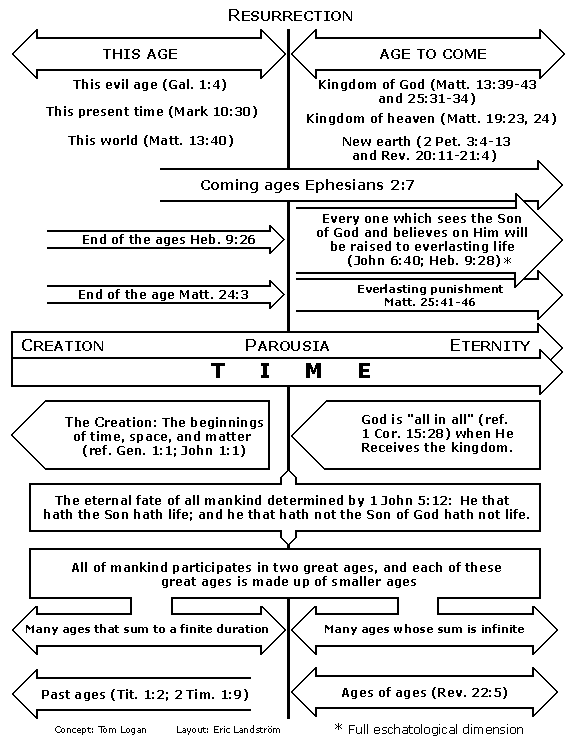 Something that is within their ability to understand
is the Hebrew concept of time. To understand the Hebrew concept
of time, you must grasp the idea that the Hebrew mind did not
think of the passage of time as a medium onto itself like the
Greek mind or how western civilization views time. Rather, to
a Hebrew, the passage of time was life. God's plan, in
the Hebrew mind, consisted that man participated in two great
ages. One age was this temporal in nature, the other great age
was the age to come. Each of these great ages were divided up
into smaller ages by events that occurred through life. Ultimately
the sum of the temporal age was finite, and the sum of the age
to come was infinite, which is to say, everlasting. Hence, the
rendering of "ages of ages" while technically correct,
completely fails to convey the meaning to the western reader.
Therefore, to render the English as "for ever and ever"
is correct, because this does explain the idea of the passage.
However, if you are a universalist whom disbelieves this explanation,
I encourage that you don't trust me, instead learn of the truth
for yourselves from an expert. To accomplish this, I ask that
you seek out your local synagogue and speak with the rabbi you
find there. For starters, the rabbi is a completely neutral source
of information; because his view will most likely be that we are
both members of a really big cult called Christendom, and as such,
he won't care one way or another. Get the rabbi to explain how
Old Testament Hebrews viewed time. While ages of ages is a correct
possible grammatical construction from an Old Testament Hebrew's
point of view -this means "forever and ever" to the
same Old Testament Hebrew when it refers to the age to come, the
after life. Thus any translator interested in translating what
is meant by the phrase in the original language will render the
Greek "for ever and ever" or the like when applicable
in English.
Something that is within their ability to understand
is the Hebrew concept of time. To understand the Hebrew concept
of time, you must grasp the idea that the Hebrew mind did not
think of the passage of time as a medium onto itself like the
Greek mind or how western civilization views time. Rather, to
a Hebrew, the passage of time was life. God's plan, in
the Hebrew mind, consisted that man participated in two great
ages. One age was this temporal in nature, the other great age
was the age to come. Each of these great ages were divided up
into smaller ages by events that occurred through life. Ultimately
the sum of the temporal age was finite, and the sum of the age
to come was infinite, which is to say, everlasting. Hence, the
rendering of "ages of ages" while technically correct,
completely fails to convey the meaning to the western reader.
Therefore, to render the English as "for ever and ever"
is correct, because this does explain the idea of the passage.
However, if you are a universalist whom disbelieves this explanation,
I encourage that you don't trust me, instead learn of the truth
for yourselves from an expert. To accomplish this, I ask that
you seek out your local synagogue and speak with the rabbi you
find there. For starters, the rabbi is a completely neutral source
of information; because his view will most likely be that we are
both members of a really big cult called Christendom, and as such,
he won't care one way or another. Get the rabbi to explain how
Old Testament Hebrews viewed time. While ages of ages is a correct
possible grammatical construction from an Old Testament Hebrew's
point of view -this means "forever and ever" to the
same Old Testament Hebrew when it refers to the age to come, the
after life. Thus any translator interested in translating what
is meant by the phrase in the original language will render the
Greek "for ever and ever" or the like when applicable
in English.
The objections of Universalists
Universalists have raised six objections to understanding aionios and aion properly rendered to convey the meaning of the words in English. The first of these is that only the scholarly can understand it. This is fallacious thinking. There is no need to be a scholar to understand the Hebrew concept of time, but having no knowledge precludes any information of special revelation. It is written in the Book of Hosea, "My people are destroyed for lack of knowledge..." (Hosea 4:6). As a Christian in the pursuit of maturity, your profession is to gain more knowledge of the Lord and to freely share that knowledge with others. Secondly, if you need to be a scholar to properly understand this, then you are not placing your trust in God, but in people whom are most agreeable to your theology.
The second objection involves the figurative fallacy on the part of the universalist. The Figurative Fallacy is: Either (1) mistaking literal language for figurative language or (2)mistaking figurative language for literal language. The question is not, "Should we interpret the passage literally or symbolically?" The question is "Which part must be interpreted literally and which part symbolically?" Like onto that, universalists further error by failing to discern that the Bible often times speaks of spiritual things rather than temporal things. In a nutshell, the only rebuttal the universalist offers with this argument against rendering these words as to mean "endlessness" and the like, is from verses where the rendering "forever" or "endless" is obviously figurative or spiritual. The universalist, by making this argument insults both the reader and their own intelligence in a desperate attempt to cling to their unscriptural position.
The third objection is that there are alternate theories available as to what the Hebrew concept of time is and that these alternate theories would tend to support the universalist position. Obviously when the authors wrote the epistles and Gospels they were to be understood by the author's intended audience. Since for the most part they were written to the Jews first and to the Gentiles second, we really should leap the historical gap between our cultures and understand the Hebrew concept of time rather than tickle our ears with theories.
Since the Hebrew concept of time has been preserved by an entire nation of Jews, it is rather easy to find out what they thought then and still what the non westernized Jews think now rather than attempt to lay the foundations of our faith on the sand of theory and speculation. Before the fact of what the Hebrews did believe then, and do believe now, the alternate theories argument evaporates.
The fourth objection universalists present is that several verses point to there being "ages" for believers yet to come in the after life, citing Ephesians 2:7 for example. The Bible refers to past ages in order to exalt God in His knowledge as the divine Creator in parallel with human ignorance (Isaiah 64:4; Deut. 4:32). The New Testament reveals the hidden wisdom of God, the Gospel, is a mystery that is revealed after long ages (1 Corinthians 2:7; Colossians 1:26; Romans 16:25; 2 Timothy 1:9; Titus 1:2).
With that in mind, the present era is the end of the ages according to 1 Corinthians 10:11; Hebrews 9:26; and 1 Peter 1:20. In reference to Ephesians 2:7, the church as it lives in this age looks forward to the age of future consummation. Though the saved exist in this age, they are born from above as new creatures at the moment of their salvation. Now is a the dawn of a new age for them while they live in an age that is yet to end. These believers also look forward to the next age in which they will be incorruptible, conformed to the image of Christ (ref. Romans 8:29). Therefore when Ephesians 2:7 speaks of ages to Christians, it speaks righteously because Christians whom are born from above participate in two ages with the blessings of the Lord -the end of this age, and the coming kingdom of God.
Hence, Ephesians 2:7 isn't speaking of multiple ages that take place in the coming kingdom of God in the after life as the universalists must have occur to support their unscriptural position of purgatory.
The fifth objection is based on the semantic range of the Greek words. While it is technically true that the words need not always be rendered forever and the like, this is only true when the Greek word refers to this world age. Therefore, I'm not arguing that the Greek, when referring to this temporal world or age, means eternal -that is not the point of contention. The point of contention is how long is the age to come going to last. The universalists insist that the next age is also finite to support their doctrine of purgatory. This is what the universalist argument supports, and their argument has no basis outside of the semantic range of the grammar.
If for example if I say to you, "bar," what am I talking about? A salad bar? A drinking establishment? Atmospheric pressure? A metal bar? What? Just because the semantic range of a word encompasses several different meanings doesn't allow you to say the text alone determines meaning. Rather the author alone determines the meaning of the text. Therefore, we must jump the historical gap and understand the Hebrew concept of time, which is understood to be that the next age is without end in order to properly understand the message that was to be conveyed.
The sixth objection universalists raise, like onto the fifth objection, is that the Greek word that is translated into eternal is "aionion." It comes from the Greek root "aion" meaning "age" which while true is not a reasonable objection because, while technically the word does mean "age," linguistically with the intent to convey the meaning the word "age" had to a Hebrew of the biblical period it should be understood as to mean eternity. As Tom Logan rightly pointed out the beliefs of an Old Testament Hebrew; "Man lives his life in two periods or worlds. There is the temporal here and now. This of course is finite and an age or ages in this life are of necessity finite. Then there is the afterlife which takes in man's existence after death. Since these are the only two forms of existence man participates in and God has made provision for an unending existence for man; the age i.e. duration or ages of this period is infinite."
As Tom continued, "The fact is as lexicons acknowledge the respective cultures (Greek and Hebrew), both had a belief in an endless afterlife and used terms based on aion and olam to refer to it."
The universalist argues that age implies that it is a period of time that comes to and end. To really examine if the universalists interpretation of age carries weight, we ought to be consistent with their application and meaning of the word "age." Therefore if we apply their argument consistently, all of the following shall also come to an end:
Greek word "aion" used of God's glory
1. Philippians 4:20 "Now unto God and our Father be glory for ever and ever. Amen."
2. 1 Timothy 1:17 "Now unto the King eternal, immortal, invisible, the only wise God, be honour and glory for ever and ever. Amen."Greek word "aion" used of God's throne
Hebrews 1:8 "But unto the Son he saith, Thy throne, O God, is for ever and ever: a sceptre of righteousness is the sceptre of thy kingdom."
Greek word "aion" used of God's duration
1. 1 Peter 1:23 "Being born again, not of corruptible seed, but of incorruptible, by the word of God, which liveth and abideth for ever."
2. 1 Peter 4:11 "If any man speak, let him speak as the oracles of God; if any man minister, let him do it as of the ability which God giveth: that God in all things may be glorified through Jesus Christ, to whom be praise and dominion for ever and ever. Amen."
3. Revelation 1:6 "And hath made us kings and priests unto God and his Father; to him be glory and dominion for ever and ever. Amen."Greek word "aion" used of the saints
1 John 2:17 "And the world passeth away, and the lust thereof: but he that doeth the will of God abideth for ever."
Greek word "aion" used of heaven
Matthew 25:46 "but the righteous into life eternal."
Greek word "aion" used of hell
1. Matthew 25:46 "And these shall go away into everlasting punishment: but the righteous into life eternal."
2. 2 Thessalonians 1:9 "these will pay the penalty of eternal destruction, away from the presence of the Lord."
3. Matthew 25:41 "Depart from me, ye cursed, into everlasting fire, prepared for the devil and his angels"
4. Jude 13 "for whom the black darkness has been reserved forever"Greek word "aionios" used of heaven
Luke 18:30 "in the age to come, eternal life."
Greek word "aionios" used of hell
1. Revelation 14:11 "And the smoke of their torment goes up forever and ever; and they have no rest day and night."
2. Revelation 20:10 "they will be tormented day and night forever and ever."
Despite the efforts of men to override the clear teaching of the Bible, the Bible is clear about the eternal nature of the punishment of the wicked. "And these shall go away into everlasting punishment: but the righteous into life eternal" (Matt. 25:46). It is easy to see that Life is the same in duration as is the Punishment of the wicked. If one is temporary, so is the other. If the punishment of those held within the lake of fire is temporary, heaven is also temporary.
The New Testament use of the words eternal and everlasting makes it clear what they mean. It is "everlasting punishment" (Matt. 25:46). The fire is "everlasting fire, prepared for the devil and his angels" (Matt. 25:41). There will be "eternal damnation" for some (Mark 3:29). For emphasis, consider how other verses use these words:
1. God is everlasting. "According to the commandment of the everlasting God" (ref. Romans 16:26). Does everlasting mean unending or temporary? Will God cease to exist?
2. The Holy Spirit is eternal. "Who through the eternal Spirit offered himself without spot to God" (ref. Hebrews 9:14). Is the Holy Spirit temporary? When the lake of fire gives up her dead, will He go out of existence?
3. Redemption is eternal. "Neither by the blood of goats and calves, but by his own blood he entered in once into the holy place, having obtained eternal redemption for us" (Hebrews 9:12) Is Christ's work of eternal redemption completed or was it for just a brief time?
4. Salvation is eternal. "He became the author of eternal salvation unto all them that obey him" ( ref. Hebrews 5:9). Will salvation also be temporary as well?
5. The kingdom is an everlasting kingdom. The faithful will be in "the everlasting kingdom of our Lord and Saviour Jesus Christ" (2 Peter 1:11). Will the end to the suffrage of the wicked in the lake of fire also earmark the end of the kingdom of God?
The same words in both Greek and English are used to describe the future punishment of the wicked that are used to describe God, the Spirit, salvation, and the kingdom. "Depart from me, ye cursed, into everlasting fire, prepared for the devil and his angels" (Matt. 25:41). Therefore, the fallacy with even arguing how long the duration of "aion" and "aionios" as to mean an age or duration of time less than forever and ever and to mean something other than time everlasting to support the doctrine of universal reconciliation is that then the same argument can be applied to heaven, God, and the everlasting life of the saints. In this the universalist is not consistent with their argument of what these words mean. Further, any objections to aion and aionius being rendered as "for ever" in English and not specifically covered here will be based on such scanty factual evidence or philosophical reasoning as to be made untenable to be the basis of one's belief in universalism.
"For the grace of God that bringeth salvation hath appeared to all men, Teaching us that, denying ungodliness and worldly lusts, we should live soberly, righteously, and godly, in this present world; Looking for that blessed hope, and the glorious appearing of the great God and our Saviour Jesus Christ; Who gave himself for us, that he might redeem us from all iniquity, and purify unto himself a peculiar people, zealous of good works" (Titus 2:11-14).
Theological Issues
1. Is there really a second chance
for salvation after physical death?
2. Is one's salvation based on one's level of light/desire
for God, or is salvation based on a true knowledge of and repentant
response to the death, burial, and resurrection of the Lord Jesus
Christ in a person's normal lifetime?
3. Does Scripture teach the ultimate reconciliation
of all things in such a way that the ongoing, eternal existence
of hell, Satan, demons, and unbelievers would be a contradiction
or that would militate against God's full glory (cf. John 12:32;
1 Cor 15:28; Eph1:10; Phil 2:10-11)?
Key Words
aiwn /aiwniov (aion, aionios)
1. Context strongly determines the meaning of eternity/eternal,
whether it be "for an extremely long time" or "forever."
2. With rare exceptions (e.g., Rev 19:3), the plural
is always used in
the sense of "forever."
3. Would not Rev 14:11 indicate an eternal experience
not just eternal
results, as also the lake of fire experience (Rev 20:10)?
4. The use of the plural aiwna (aiona)
in Jude 13 to describe the
experience of "black darkness" is utterly unexpected
and
unnecessary if universalism were in view (cf. 2 Pet 2:17 where
aiona is not used).
Also see The Hebrew Concept of Time
The Severity of God (Romans 11:22)
(Write an introduction. This section needs to explain the purpose of judgment and the order of events surrounding it.)
Pondering upon the justice of God gives rise to the question: what is the object of God's wrath? The answer is sin. Likewise, what is the object of God's love? To have us set apart from sin. As a parent disciplines a child, so God disciplines us to set us apart from sin. God does this to His glory because He is set apart from sin. God desires us to be holy because He is holy. Therefore, does a just and righteous judge leave evil alone? Does a good judge refuse to dispense justice? The result of the answers to these questions is that God would not be good if He didn't punish the wicked.
But the question remains, what of those who have rejected Christ? You will recall that all will know who God is when they are resurrected together (Dan 12:2; John 5:28-29; Acts 24:15; in his own company 1 Cor. 15:23) to give account to God as 2 Corinthians 5:10 says:
For we must all appear before the judgment seat of Christ; that every one may receive the things done in his body, according to that he hath done, whether it be good or bad.
It is at this judgment that it is clearly written all will give knee to God after the resurrection in Romans 14:10-12:
10 But why dost thou judge thy brother? or why dost thou set at nought thy brother? for we shall all stand before the judgment seat of Christ. 11 For it is written, As I live, saith the Lord, every knee shall bow to me, and every tongue shall confess to God. 12 So then every one of us shall give account of himself to God.
Clearly this passage tells us that all bow and give knee to God at judgment. Universalists argue that it is at this time when all give knee to the Creator that all are saved, and that God is truly "all in all." But does one need to be saved in order to bow in recognition of the power and authority of the court that will issue righteous judgment to all? The answer is: no, one does not need to be saved to recognize the authority of the judgment seat, just as a defendant in a court of law that will later be found guilty need not be exonerated before the trial to accept the ruling of the court. However, if the universalist doesn't accept this argument; it can be pointed out that after the judgment there are two groups -all the saints and all the wicked. Therefore, we can conclude that there are two different "all's": All the wicked and all the saints. We know the saint's are happily with God, but can we show how the wicked can get to God by getting out of the lake of fire which they were sent and by getting their names entered back into the book of life?
The universalist would try to explain that everyone gets out of the lake of fire at Revelation 20:13, but a careful look at this verse shows fallacious reasoning and dishonestly toward the Holy Spirit by declaring in the name of God something He never meant to convey. This is because a careful look reveals that it is death and hades that are delivered up before the judgment of the Lord, which is to say, everybody is resurrected to appear before the judgment seat of God. Therefore, it is shown that the wicked are not removed from the lake of fire, called hell, but are removed from hades to appear before the Lord. This is what Revelation 20:13 is talking about and not the wicked being raised from the lake of fire.
When a universalist proclaims that God shall be "all in all" (referencing 1 Corinthians 15:28), it would be wise to also look at 1 Corinthians 12:6 and Ephesians 1:23 where the same phrase, "all in all" is rendered from the Greek panta en pasin. The phrase "all in all" does not, as the universalist asserts, point to a time when all peoples are saved. Rather the phrase points to the unity in Spirit that believers possess. As noted earlier, Ephesians 4:13 says, "Till we all come in the unity of the faith, and of the knowledge of the Son of God, unto a perfect man, unto the measure of the stature of the fulness of Christ." The "perfect man" doesn't refer a person who is saved in a time when God is "all in all" as commonly the universalist would assert. Rather, the perfect man is Jesus Christ as He shall be when His church is completed and manifested as His Body, "the fulness of him that filleth all in all" (ref. Ephesians 1:23).
But it need not be that in order for God to be "all in all" that all must be in God. If we examine the context of the passage that the universalist basis' his claim from (1 Corinthians 15:24-28), through careful exegesis it is revealed that Paul is not speaking of the salvation of all peoples, but rather of condemnation. This is evident in such phrases as destroy, put under his feet, and put an end to all rule. This is the language of subjugation (see verses 24, 27, 28). Those in view are spoken of as God's "enemies," not His friends or children. They are subjugated enemies, not saved friends. That God will be "all in all" (verse 28) does not mean that all will be in God. He will reign supreme in all the universe after ending the rebellion against Him. The phrase all things must be understood in its context. All things are made subject to Christ (verse 28). But these "all things" are enemies (verse 25). The phrase is used in parallel with enemies in successive verses (verses 26-27). It is fallacious logic, as some universalists have reasoned, that in order to be subjugated one must be saved. Need a criminal be proven innocent to be subjugated to the ruling of the court that will administer his punishment? The answer, of course, is no. Therefore when all enemies are subjugated and put under God does not mean that they must all be saved in order for this to come to pass.
With this in mind, we ought to wonder if the lake of fire is the final fate of the wicked. Searching among the many verses that teach us that the fate of the wicked is eternal separation from the Lord, we find two verses that stand out:
The LORD is slow to anger, and great in power, and will not at all acquit the wicked: the LORD hath his way in the whirlwind and in the storm, and the clouds are the dust of his feet (Nahum 1:3).
He that is unjust, let him be unjust still: and he which is filthy, let him be filthy still: and he that is righteous, let him be righteous still: and he that is holy, let him be holy still (Revelation 22:11).
What the verse from Nahum teaches us, is that in all of God's power and authority, even God Himself shall not ever acquit the wicked. To say that God will acquit the wicked is in direct contradiction to this verse.
The verse from Revelation 22:11 is particularly damaging to universalism because if this verse speaks the truth (and it does), no matter where it is placed, it means the unjust stay unjust and the righteous stay righteous. For example, if this verse is placed after judgment, then no matter what -the unjust stay unjust and the righteous stay righteous. If Revelation 22:11 is placed after the resurrection, but before the judgment then even after the judgment the unjust stay unjust and the righteous stay righteous. If this verse is placed during a temporal lifetime, then the Calvinist is correct because the unjust stay unjust and the righteous stays righteous. Wherever this verse is placed it refutes the doctrine of universalism because certainly people die without believing the righteous Gospel of Christ Jesus in rejection of the Lord in heaven.
Objection: If the Lord is omnipresent, but not "in hell" (i.e., He is separated from the wicked), aren't these two contradictory statements? Answer: It is a paradox (explain a paradox), but consider that if everything seen and unseen were removed, if God would not exist? The question is rhetorical, because God would still exist. Yet this seems to be a valid objection if one fails to understand how God makes himself present everywhere.
The Omnipresence of God in Hell
Thomas Oden noted in his systematic that the infinite is that which has no end, no limit, and no finite boundary, thus that which is infinite cannot be measured or timed by any finite standard. Infinity, rightly conceived, can belong only to God alone. By definition that which is infinite cannot be applied to any finite creature, even though the creatures themselves may participate in the infinity of God. Thus notions of infinite time and infinite space tend to be self contradictory and confusing because space and time, being finite, cannot be extended infinitely. It is only when infinity is attributed to God alone that the concept has precise, plausible, and a consistent meaning.
Space and time are transcended by the infinite God, making terms like beyond and trascended inexact and usable only in a metaphorical sense. God is both infinitely near and infinitely far, yet speaking in this way we do not imply that God is finitely localized in one place, be it here on this earth, heaven, or hell (The Living God).
Omnipresence is God's method of being present to all ranges of both time and space. Although God is present in all time and space, God is not locally limited to any time or space. God is everywhere and in every now. No molecule or atomic particle is so small that God is not fully present to it, and no galaxy so vast that God does not circumscribe it. But if we were to remove creation, God would still know of it, for He knows all possibilities, whether they are actual or not.
but some disagree saying that God is not aware or present with those who are in hell and is unaware of the transpirings within its boundaries. To this idea, I say no, for God is everywhere present and knows all things, even those who are removed from his blessings an dwell in the confines of hell. Thus because God is everywhere present he is definitely aware of hell and it's contents and for this very reason has broken off all fellowship with it's occupants, His blessing are departed, His wrath is ushered in. Yet, God in His infinite mercy, allows the occupants to continue to exist rather than to snuff them out because of their intrinsic value, for something is greater than nothing, having life, no matter the condition, is better than having no life. Thus God's presence in hell works both to sustain the occupants and through the anguish of sin punish those before his holy presence.
Thus, I affirm that lake of fire is before God, that God is present within it and present within it's occupants, but I deny the idea of process theology, or that of eminence, the idea that creation emanates from the being of God because it doesn't differentiate clearly enough that the creation is not God. Hence, hell is a state that is in the presence of God, but not in a state of a blessing presence of God.
The lexical definition of the word commonly translated presence from Rev. 14:10:
enopion, in the face of (literally or figuratively):-before, in the presence (sight) of, to.
Let us give answer to the gainsayer:
Many have questioned God's own omnipresence in the lake of fire. Some think that the lake of fire, called hell, is appalling because of the absence of the presence of the Lord. Hell is hell, i.e., tormenting, dark, depressing, and the like, because God is not there. But if we were to say that God is not immanent before the lake of fire, then we must say that God is not omnipresentor "everywhere present". That would limit God's omnipresence by saying He is not in hell. That produces another question, "If God is love, how can a loving God be in the lake of fire? I always thought those in hell wanted God to be present there since they are 'separated' from Him?" The Scriptures show that God on His judgment seat, says this in sending wicked rebellious sinners to hell, "Depart from Me you cursed, into the everlasting fire prepared or the devil and his angels..." (Matthew 25:41). Some attempt to interpret the word depart as, "depart from my very presence because I am not there." But the Bible does not interpret itself in that same way. Psalm 139:8 states, "If I ascend to heaven, you are there; if I make my bed in hell, behold, You are there." God is present before and within the lake of fire or God is not omnipresent. How can we reconcile this? Matthew 25:41, in its proper context, means, "departing" from the blessing and glorious presence of God in eternal bliss, not "departing" from God all together. God is in hell at this very moment. Hell is hell because of sin. Hell is hell because God's glorious presence is there in contrast to the depravity of sin. The condemned would do anything have five seconds of relief from the glory of God. They would give anything for God to depart from them for a moment so they could rest from their eternal pains, but there is no rest for the wicked. All those in the lake of fire deserve every measure of righteous judgment for their sin that they perished with.
The difficulty of grasping the Lord's presence in hell can be understood by realizing how God is described by Scripture to be present throughout His creation. By witness of the Scripture, God is said to be present to bless, to sustain, or to punish. King David speaks of God's presence to bless: "Thou wilt shew me the path of life: in thy presence is fulness of joy; at thy right hand there are pleasures for evermore" (Psalm 16:11). Yet all things are sustained by the Lord's presence so that they both exist and function as the Lord allows. "And he is before all things, and by him all things consist" (Col. 1:17). In this sense the Lord our God is everywhere present and to this the author of Hebrews agrees, writing of Christ that He is "upholding all things by the word of his power" (Heb. 1:3). The third way the Lord is present is described by this unsettling passage delivered through the prophet Amos:
Amos 9:1 I saw the Lord standing upon the altar: and he said, Smite the lintel of the door, that the posts may shake: and cut them in the head, all of them; and I will slay the last of them with the sword: he that fleeth of them shall not flee away, and he that escapeth of them shall not be delivered.
Amos 9:2 Though they dig into hell, thence shall mine hand take them; though they climb up to heaven, thence will I bring them down:
Amos 9:3 And though they hide themselves in the top of Carmel, I will search and take them out thence; and though they be hid from my sight in the bottom of the sea, thence will I command the serpent, and he shall bite them:
Amos 9:4 And though they go into captivity before their enemies, thence will I command the sword, and it shall slay them: and I will set mine eyes upon them for evil, and not for good.
Similarly Isaiah 59:2 reports that "your iniquities have separated between you and your God, and your sins have hid his face from you, that he will not hear," as well as Proverbs 15:29 which declares: "The LORD is far from the wicked: but he heareth the prayer of the righteous." Within the context of God's omnipresence, this doesn't say that God is not present whatsoever, but that He is not making His presence known by delivering blessings upon his people.
Therefore to summarize: God is present in every part of his creation yet God acts according to circumstances of each particular place. Most of the time God is present to bless when His presence is spoken of in Scripture, but this is not true in every case, for clearly He is present to sustain as well as punish if needs be.
Herman Bavinck writes of God's omnipresence: "When you wish to do something evil, you retire from the public into your house where no enemy may see you; from those places of your house which are open and visible to the eyes of men you remove yourself into your room; even in your room you fear some witness from another quarter; you retire into your heart, there you meditate: he is more inward than your heart. Wherever, therefore, you shall have fled, there he is. From yourself, whither will you flee? Will you not follow yourself wherever you shall flee? But since there is One more inward even than yourself, there is no place where you may flee from God angry but to God reconciled. There is no place at all whither you may flee. Will you flee from him? Flee unto him" (cited by Wayne Grudem, Bible Doctrine, p. 81).
Sources
Thomas Oden, Systematic Theology, Prince Press
Wayne Grudem, Bible Doctrine, Zondervan
Robert A. Peterson, Hell on Trial: The Case for Eternal Punishment, Presbyterian & Reformed Publishing Company
Edward William Fudge and Robert A. Peterson, Two Views of Hell: A Biblical & Theological Dialogue, Intervarsity Press
Norman Geisler, Encyclopedia of Christian Apologetics, Baker Book
The Denial of the Lake of Fire.
"Contemporary teachers of this error [universalism], like their earlier counterparts, attempt to persuade the gullible by citing certain Scriptures (often out of context) which they contend teach the doctrine of ultimate reconciliation, while they carefully neglect to quote those passages which clearly refute their heresy." Hobart E Freeman, Every Wind of Doctrine, p. 149.
"The soul after death is said to be reincarnated again on earth in another body to take up the problems where the individual left off. Instead of a resurrection there are repeated incarnations which are the merciful provision of God to give everyone sufficient opportunity to live a perfect life and attain the immortality as did Jesus. According to Unity, John the Baptist was the reincarnation of Elijah (Matt. 11:14), and Jesus was David reincarnated (Matt. 22:42).
Any return after death is, however, clearly denied by Hebrews 9:27." Hobart E Freeman, Every Wind of Doctrine, p. 146
In this regard, the universalist that denies the lake of fire altogether fully believes in a form of reincarnation (though they would avoid the term at all costs, just as the universalists whom believe man is redeemed through the passage of the lake of fire will avoid the term purgatory at all costs). This cycle of rebirths, which universalists call ages, gives the person opportunity to redeem the mistakes of the past through repentance and this is continued until he is found worthy to enter fellowship with God (i.e., all in all, ref. 1 Cor. 15:28). Therefore, salvation comes by attaining spiritual perfection, whereby a person delivered from the continuous cycle of ages, by acceptance that Jesus died for all sins. This does not mean that a person must have a personal relationship with Jesus Christ as their personal Savior, but rather, that they must believe that He died for all sins. This form of belief distracts from Jesus Christ as Lord and Savior and places the emphasis on a particular doctrine of salvation. It is a subtle, but important error.
The universalists whom deny the lake of fire have fallen into a "Christienized" form of the Unity school of theology. They attempt to support their beliefs on proof texts from the Bible and the argument that some people seem to recall pasts lives.
Attempts to find Biblical evidence to support the notion of purification through the transcendence of ages to come are generally refuted by the context of the passages the universalist cites to support their doctrine. Alleged references are supposed to be found in Matthew 17:11-13; Luke 9:18-19; and John 9:1-3.
The passages in Matthew in which Jesus prophetically and symbolically refers to John the Baptist as "Elijah" does not teach reincarnation, for the reference here is only to the fact that John was said to have come to prepare the way for Jesus and would "go before him in the spirit and power of Elias [Elijah]" (Luke 1:17). Moreover, John the Baptist himself emphatically denied that he was Elijah returned (John 1:19-23). Certainly he should have known who he was. Anyway, he claimed to be the prophet spoken of by Isaiah (40:3), not Malachi (who predicted the coming of Elijah, Mal. 4:5-6).
The obvious meaning of the second passage, Luke 9:18-19, is certainly not reincarnation, but merely indicates Jewish speculation as to the possibility of the resurrection of an Old Testament saint or prophet (think about the two witnesses of Rev. 11).
In John 9:1-3 the universalists argument for purification through the transcendence of ages is based upon the disciples question in verse 2, which reads: "Master, who did sin, this man, or his parents, that he was born blind? This indicates, we are informed that the man may have sinned in another life, resulting in his being born again in an age to come. However, this error results from a misreading of the sense of the verse, which is simply, "Who did sin, this man (which resulted in his blindness), or his parents, that he was born blind? The reference to being born blind is obviously only in regard to his parents, and the possibility of parental sin on their part as the cause. Jesus' reply, furthermore, gives no basis whatsoever for a reincarnation or sin in a previous life. He certainly had here the most appropriate opportunity to teach reincarnation if the doctrine were true. It is strange that a doctrine as important to one's salvation as reincarnation is nowhere taught in Scripture, but must be "read into" the text by those who advocate it. All Jesus would have had to have done in any of these passages to prove that man is redeemed through the transcendence of ages to come, was state it as true. But, on the contrary, everything He taught concerning man, sin, salvation (by faith and not works--either through suffrage in the lake of fire, i.e., penitence, or the purification of the soul through the ages), and the judgment to come, was clearly opposed to this error (Gal. 2-3; Eph. 2:8-9; Heb. 10:12-14).
The Sriptures refute the fallacy of reincarnation, teaching that death forever seals mans destiny either for good or evil, for "it is appointed unto men once to die, but after this the judgment: So Christ was once offered to bear the sins of many; and unto them that look for him shall he appear the second time without sin unto salvation" (Hebrews 9:27-28, emphasis mine). Notice that there is only one death, not many deaths. That the sins that are borne by Jesus are many, not all (though Jesus did die to atone for all sins), and that Jesus (i.e., God) shall only appear to those that look for Him.
Furthermore, there is no mention to the repentant thief on the cross of his need for purification in ages to come to undo his sins. On the contrary, Jesus promised him, "To day shalt thou be with me in paradise" (Luke 23:43; ref. 2 Cor. 5:8; Rev. 22:7, 11).
Jesus in Luke 16:19-31, stated that at death there is an inseparable gulf fixed between the righteous and the wicked. That is the "big idea" from the passage whether you accept it as a literal story, or a parable, that is the truth Jesus conveyed. In effect John affirmed the fate of all mankind when he wrote: "He that hath the Son hath life; and he that hath not the Son of God hath not life" (1 John 5:12). Just as the prophet Jeremiah affirmed that Lord said, "Behold, I set before you the way of life, and the way of death" (Jeremiah 21:8).
The misguided belief in self atonement through the transcendence of ages to come to be able to enter fellowship with the Lord at which the Lord in heaven shall be "all in all" denies the need for blood atonement. What it states is that Jesus' work on the cross only allows for the possibility to enter into fellowship with the Lord, but to do so, the seeker of God must purge from himself his wickedness to attain spiritual perfection through his own moral efforts. This belief is clearly refuted by 1 John 1:9, which promises, "If we confess our sins, he is faithful and just to forgive us our sins, and to cleanse us from all unrighteousness." Thus, it follows that universalism is a rejection of the Bibles teaching of final judgment of the lost (see Matt. 25:31-46; Mark 9:43-48; John 3:36; Rev. 20:11-15). Being saved, is to receive eternal life, it is a spiritual rebirth (John 3:1f), "Being born again, not of corruptible seed, but of incorruptible, by the word of God, which liveth and abideth for ever (1 Peter 1:23).
Those whom deny an eternal conscious punishment in the lake of fire are refuted by Isaiah 66:24; Malachi 4:1; Matthew 25:46; Mark 9:43-48; Revelation 14:9-11; 19:2-3; 20:10-15; 21:8, 14:15, 22:11.
There Shall Be a Final Judgment
The Bible unequivocally teaches the existence of sin and its consequences. Whether the world wants to admit it or not, sin is a reality. Romans 3:23 states, "For all have sinned, and come short of the glory of God;" When God created mankind He gave us a choice as to how we would act (Gen. 3:2-6). Sin is the act of breaking God's laws, through either omission by not doing what He desires us to, or commission, which is doing that which our Lord in heaven has forbidden us to do. In 1st John 3:4 we read, "Whosoever committeth sin transgresseth also the law: for sin is the transgression of the law." When we go contrary to God's word we have sinned before the eyes of our holy God, whether we are aware of it or not. The Bible not only teaches that we all sin, but it also teaches we will all give an account for how we have lived our lives at a coming judgment. This is the great and terrible day of reckoning. The author of Hebrews promised us, "And as it is appointed unto men once to die, but after this the judgment" (Heb. 9:27). Paul pointed out in 2nd Corinthians 5:10, "For we must all appear before the judgment seat of Christ; that every one may receive the things done in his body, according to that he hath done, whether it be good or bad." In Matthew 25, we find three descriptions of the great day of judgment. Jesus spoke of ten virgins, three men who received various talents, and a division of sheep and goats. In all three stories there were people ill-prepared in the day of judgment. In every case Jesus clearly points out the doom awaiting those who are for what ever reason not equipped when He comes to separate His faithful people from those who follow Satan.
Either we are Christ's dsciples or else we are not. If a person is not a follower of Christ then he an enemy of Christ. Many people would not see themselves as the Lord's enemies, but Jesus defined all unbelievers as His enemies. Jesus, in Matthew 12:30 prnounced, "He that is not with me is against me; and he that gathereth not with me scattereth abroad." One does not have to be a rank hedonist or a rabit atheist to be against Christ.
But this understanding opposes that of universalism and universalism itself must oppose the Bible, for it is writen in 2 Peter 2:9: "The Lord knoweth how to deliver the godly out of temptations, and to reserve the unjust unto the day of judgment to be punished."
I think it would be wise to take a look at the Book of Romans where Paul is explaining judgement because some universalists actually deny that God will judge his creation whatsoever. Therefore, it is necessary to point out a biblical truth, that all will indeed be judged and that after this judgment there shall be two groups: All the saints and all the wicked.
2 But we are sure that the judgment of God is according to truth against them which commit such things. 3 And thinkest thou this, O man, that judgest them which do such things, and doest the same, that thou shalt escape the judgment of God?
Paul is asking a question; do you think that, as a sinner, you shall escape judgement?
4 Or despisest thou the riches of his goodness and forbearance and longsuffering; not knowing that the goodness of God leadeth thee to repentance?
Do you deny God's judgement will lead you to repentance?
5 But after thy hardness and impenitent heart treasurest up unto thyself wrath against the day of wrath and revelation of the righteous judgment of God;
Do you deny that your unrepented sins are not storing up there measure of God's wrath? For the universalist, it should be contemplated just how God shall administer His wrath.
6 Who will render to every man according to his deeds:
For God will dispense justice accordingly.
7 To them who by patient continuance in well doing seek for glory and honour and immortality, eternal life: 8 But unto them that are contentious, and do not obey the truth, but obey unrighteousness, indignation and wrath,
And here we see the two groups separated out. You may want to look at Matthew 27:51-53 1 Corinthians 15:23 and Daniel 12:2 two see that in this general resurrection all are indeed raised in their order. First the firstfruits after Christ for the coming general harvest and then the general resurrection. This all occurs on the last day at the second coming of Christ; the day of Judgement.
Because we have determined that to be saved, one must have faith; and because we have determined that the Bible speaks of two groups of "all" and having determined the fate of the wicked "all," we can therefore conclude that the universalist idea of all being saved is not biblical. Salvation is for the here and now. I ask those of you whom believe in the salvation of all peoples to recognize that your faith in a doctrine of all being saved shall not save you. Only a personal relationship with Jesus Christ shall bring you saving faith, for it is Him alone that saves. In the words of Jesus Christ Himself taken from John 11:26: "And whosoever liveth and believeth in me shall never die. Believest thou this?"
Mat. 25:31,32; Heb. 9:27; 2 Peter 2:9; 3:7; 1 John 4:17; Jude 14, 15
There will be a judgment: John 12:48
Ultimately universalists rest their final authority not in Scripture, but in the musings of men.
Diversionary Tactics
Christian universalists like to refute the false concept of hell invented by an antagonist named Danté. When Universalists refute this concept of hell, orthodox Christians wonder what the point is? The universalist's position of universal reconciliation is not proved as correct, just because they prove Dante's equally false concept of hell wrong! Yet many of the outspoken Christian universalists dishonestly try to represent Dante's false view of hell as that which orthodox Christians believe. This is a common recruiting practice that universalists utilize by erecting a false argument for which they can easily refute. Within apologetic circles this is known as a strawman, for it is an argument that lacks substance.
The Difference between Hades and Hell
Though most Christian universalists are aware of the difference, it is a common practice for them to confuse the lake of fire, called hell, and hades. The lake of fire and hades are two different places at two different times. Departed spirits of men go to Hades and await judgement. After judgement, the wicked will be cast into Hell. Christian universalists, as the Arians, confuse the two either intentionally or unintentionally when speaking to each other or when "witnessing" to orthodox Christians.
Christian universalists are also fond of setting up a false dichotomy between Arminian and Calvinist beliefs. This is largely centered on the question of predestination and freewill. To do this the universalist presents the hyper views of both as the common representation of either camp. The universalist will then play upon the other in an effort to divide and conquer. When the universalist does this, he fails to understand that both Calvinism and Arminianism comfortably rest within the confines of orthodox Christianity. Further, by presenting this type of argument the universalist reveals his lack of knowledge of each position and the very Scriptural views each position represents. Regardless, both Calvinists and Arminians have no difficulty recognizing each other as brethren whom are a part of the Body of Christ because of the Spirit which they keep and the agreement of Christian fundamentals.
The Partialist Argument
(Awaiting to be written.) Acts 10:34; Romans 10:12; James 2:4 (Jude 1:16) Impartial in judgment: De. 10:17; 2 Chr. 19:7; Jer. 9:25; Rom. 2:9; Col. 3:25; 1 Peter 1:17.
Charles Finney in his sermon, Refuge of Lies, preached: "The favorite term with them [universalists] to designate their opponents is "partialists," assuming that it would be partial in God to save one and not another. This can appear plausible only to the most short-sighted intelligence. For, consider--Is a ruler impartial who treats the righteous and the wicked alike? Is this impartiality? Can justice treat men of opposite character and opposite merits, just alike? There is the case of Abraham's prayer for Sodom, "O Lord," he says, "wilt Thou destroy the righteous with the wicked?" Would that be right? That the righteous should be treated as the wicked are--"be this far from Thee, O Lord!" "Shall not the Judge of all the earth do right?"
Now here, with the best good sense and reason, Abraham assumes that God would be partial and unjust if He were to treat the righteous and the wicked all alike, and he pleads as if he felt most sure that the Judge of all the earth would do no such thing. Abraham was no Universalist. Impartiality implies dealing with men according to their deserts. Therefore if God saves all men, be they righteous or wicked, He cannot be impartial, but must be partial. Again, persons who hold this delusion must count Paul a madman. Hear him: "I say the truth in Christ; I lie not; my conscience bears me witness that I have great heaviness and continual sorrow in my heart for my brethren;" and why? He tells us, moreover, that in one city, "by the space of three years he ceased not to warn everyone night and day with tears."
But why is all this? If Paul really believed that all men will certainly be saved, what is he warning them against? And why those tears, and that continual heaviness and agony of spirit? Is he warning them to flee from the wrath to come? O no--no; but he trembles lest they should not all become Universalists. He finds that some of them are skeptical upon this doctrine, and hence are afraid of being finally lost, and he cannot endure that their minds should be disturbed by such fears for the few days of the mortal life. O he is in the greatest agony lest he shall not convert all his Jewish brethren and all the Gentiles of Ephesus to the belief of universal salvation!! He is in dreadful agony of soul lest they should be troubled with fears of being lost! Alas, lest they should never become Universalists! And this is the Universalist's version of the character of the great apostle of the Gentiles!
But what does Paul say of himself? Does he tell us that in his view of the matter, Christ saves all? Aye, he says, that for himself, "he becomes all things to all men if by any means he might save some." And this is the extent of his Universalism!
Again, this doctrine represents Christ as either full of deceit or void of sense. Hear its explanation of Christ's words: Christ says, "Fear not them which kill the body, but are not able to kill the soul; but rather fear Him who is able to destroy both soul and body in hell." Now look at the exposition put on this language by the Universalists. "Hell," he says, "means nothing but the grave. There is no other hell but the grave." Of course he makes Jesus Christ say this in the passage just cited--"Fear not the assassin or the executioner, who can only kill you; but I will forewarn you whom you should fear: fear him," who after you are dead can throw your soul and body into--the grave--aye, yes, fear the sexton!! Ah, consider--he has power to bury you after you are dead--I say unto you, fear him! Now if Universalism makes no other hell but the grave, then Universalism makes Christ either a consummately deceitful man, or a man sadly deficient of intellect!"
Limited Atonement Confusion
Along the same lines of argumentation of the Calvinist vs. Arminianism dichotomy that universalists utilize to in an attempt to divide and conquer those that would oppose the doctrine of universal reconciliation; this argument tries to paint all orthodox Christians as accepting the doctrine of limited atonement. Basically the universalist states that all Christians believe in limited atonement because only a "few" are saved and granted eternal life according to their beliefs. However by posing this argument, the universalist redefines what the term atonement means. The term atonement, as applied to Christian theology, has been historically viewed as for whom Jesus emptied Himself becoming sin for, and whom He shed His blood to atone for their sins on the cross. Hence, "limited" atonement in this application would refer to Jesus only atoning for those whom will be saved, or as it relates to Calvinism, the "elect." Thus, the universalist would present that he is on "higher" ground theologically, by showing that the blood was shed for all men (1 John 2:1, 2; Hebrews 2:9; 1 Timothy 4:10).
However, in reality this argument the universalist presents is nothing more than a ruse used to distract a witness. Just as I could mail a letter out to each and every soul whom ever walked upon the earth; in order to receive the message I sent, you would have to open the letter and read it. Like onto that, the Bible clearly teaches that Jesus did indeed die to atone for all of mans sins; but to receive eternal life (i.e., salvation), you must receive Him into your heart. Therefore, the truth is that Jesus died to atone for the sins of all men in an "ultimate" atonement. The problem is not that the atonement was limited in any way, but that the reception of this wonderful gift is limited. In answering the universalist whom redefines terms to suit his purpose to antagonize the Christian witness, in a like spirit, it can be pointed out that the universalist also believes in "limited atonement" -for by their own theology and admission, not all souls are saved by the blood of Jesus alone without the help of the lake of fire or the transcendence of time through the ages.
The Usual Suspects
In its entirety the Bible contains a number of verses in which the Christian universalist uses as proof texts in support of the theology of universal reconciliation, otherwise known as universalism. These proofs are commonly presented as a list that universalists either rattle off by memory or they are presented to the orthodox Christian witness in an attempt to overwhelm them. In written form this practice is called "bombing," and verbally it is referred to as "snowing an opponent" -as in a snow storm. Commonly in written form, the Christian universalist will diligently work in their dialogue a list such as this:
1 Timothy 2:4 God desires all to be saved
Job 23:13 Does what His soul desires
Isaiah 46:10 Does all His desire
John 12:32 Will draw all to Himself
1 Timothy 2:6 Christ a Ransom for all {the testimony in its own eras},
John 4:42 Jesus is the Savior of the world
John 1:29 Lamb takes away sin of the world
1 John 2:2 Atoning sacrifice for sins of whole world
Romans 5:18-19 By Adam all condemned, by Christ all to be justified
1 Corinthians 15:22 In Adam all die, "in Christ" all shall be made alive

(For a complete list see the Appendix.)
When a list such as this is presented
in written form, it usually follows the Christian universalist's
adamant and sincere statement that universalism is the truth.
Unfortunately, oftentimes also presented with the list is little
or no contextualization to explain exactly what the universalist
intends to convey in the presentation of such a list. Non universalists
are supposed to be able to  figure
it out on their own -which when they do, they soon come to recognize
that the universalist has ripped the proof verses they use in
support of universalism from their context. Rather than go deep
into the rules of sound hermeneutics (the art and science of biblical
interpretation) which are bent and or broken through the universalist's
exegesis, I simply recommend that you just pick up a copy of James
Sire's book, "Scripture
Twisting, 20 Ways the Cults Misread the Bible" (ISBN
0-87784-611-1), and find out all about it for yourself.
figure
it out on their own -which when they do, they soon come to recognize
that the universalist has ripped the proof verses they use in
support of universalism from their context. Rather than go deep
into the rules of sound hermeneutics (the art and science of biblical
interpretation) which are bent and or broken through the universalist's
exegesis, I simply recommend that you just pick up a copy of James
Sire's book, "Scripture
Twisting, 20 Ways the Cults Misread the Bible" (ISBN
0-87784-611-1), and find out all about it for yourself.
The universalist, when confronted by the Christian who would object to the conclusions the universalist have reached from lists such as this, runs down a rabbit trail in search of more evidence to support their position rather than dwell on the verses in question. In fact, this is the most common of the defenses universalists utilize in their defense of universalism. In this regard, the universalist is likened to the paleontologist whom argues how old fossils are by the layer of strata they are found in, but when the paleontologist is asked how he reasons how old the layers of strata are -he reveals that it is known by the kind of fossils found within it. Like onto that does the universalist reason universalism. This is circular reasoning. Both the universalist and the paleontologist approach their field of study with preconceived notions that lead them to erroneous conclusions.
While it is true that the Christian universalist has produced a list in support of his theology employing the unsound practice of wishful thinking and the shifting sands of philosophy and speculation -the list still deserves a response on the part of the orthodox Christian whom is confronting their theology and in a fashion that will not waste time by arguing in ever-growing lazy circles with the universalist. Therefore, I present an argument that utilizes the same method employed by the universalist. The whole point of my argument is that perhaps we should explore the context of each verse used in order to refute the argument. I say this because if you look, plain as day, it is written:
Deuteronomy 32:39 there is no god
1 Kings 8:23 there is no God
2 Kings 1:16 there is no God
2 Kings 5:15 there is no God
2 Chronicles 6:14 there is no God
Psalm 14:1 there is no God
Psalm 53:1 There is no God
Isaiah 44:6 there is no God
Isaiah 44:8 there is no God
Isaiah 45:5 there is no God
Isaiah 45:14 there is no God
Isaiah 45:21 there is no God
Using the same method as the Christian universalist, the Bible could lead a person to apostasy and the renunciation of both their faith and God. Of course, both the universalist and the non universalist know that the argument I proposed above is not valid. However, how would the universalist refute such an argument if it were posed by a sincere atheist? Like onto that, we should also explore the context of the verses used to support universalism by forcing the proponents of universalism to sit on each proof verse in turn and perform an honest and biblical exegesis to support their position. If this is systematically done, the universalist can be shown through the Scriptures that biblically universalism doesn't have a case.
Universalists enjoy pointing out that there are some 30,000 different Christian denominations through out the world and that this clearly indicates that the body of Christ is in a confused and fractured state, thereby, positing that universalism is the superior position because it has no such difficulties.
In consideration, we ought to acknowledge that universalists themselves generally only contend for one thing--the eventual salvation of all. They choose to overlook and not contend for other doctrines against false teachings and beliefs even when among themselves. Yet Christians, no matter which part of the body they come from are instructed to earnestly contend for all points of doctrine as exhorted by Jude 1:3. The unwillingness that universalists show by refusing to contend against any error in their view other than against the Christian whom dares say that universalism is false speaks volumes to me of the very frail unity that universalists truly possess among themselves.
Yet what kind of wishy-washiness is universalism when it lacks the conviction to contend for basic foundational Christian truths which make up the unity of the Spirit--something which all Christians possess. What feeble beliefs are they which will not contend for all Scriptural truths as they are understood? Yet universalists routinely argue that the disunity of denominationalism is a flaw in the body of Christ.
While it is true that there are many denominations that consider themselves orthodox that the body of Christ would strongly contend against, this doesn't detract from unity of Spirit consists of the seven fundamental truths all Christians recognize and adhere to. These truths are: (1) one body, (2) one Spirit, (3) one hope, (4) one Lord, (5) one faith, (6) one baptism, and (7) one God and Father. These are the "Christian fundamentals," and they are the proper and Scriptural basis for all Christian fellowship. This is the unity of the Spirit that is in all believers. As Ephesians 4:13 says, "Till we all come in the unity of the faith, and of the knowledge of the Son of God, unto a perfect man, unto the measure of the stature of the fulness of Christ."
Note for universalists: The "perfect man" referred to in Ephesians 4:13 isn't a person who is saved in a time when God is "all in all" as the universalist would claim. Rather, the perfect man is Christ as He shall be when His church is completed and manifested as His Body, "the fulness of him that filleth all in all" (ref. Ephesians 1:23).
Yet universalists present the idea that Christians do not have unity within the body? To that I would strongly disagree. For instance, I myself have no difficulty accepting a person as part of the body if they profess their faith and adhere to the fundamentals of Christendom. However, this does leave room for disagreements among the representatives of the body regarding peripheral issues.
As an example Charles Surgeon said that Calvinism should be preached as the Gospel. I would say that Dr. Surgeon woke up on the wrong side of the bed that day--but there is no denying that Spurgeon did not preach and teach the Word of God. Charles Finney evangelized a nation, and it was said of him where ever he went revival followed. He was, and still remains, one of the most influential theologians and preachers the world has known, and yet I would argue against certain things he taught until the cows came home. Of D.L. Moody, it is said that he evangelized and led well over 100 million people to the Lord around the world (a record yet to be matched by the modern T.V. evangelists), and yet he fueled the fires that led to hyper dispensationalism. All these men had some error in their understanding by the weight of Scriptures, yet by their fruits, as Christians, we cannot deny that they were not instruments and servants of our glorified Lord in heaven. Nor do I propose that my understanding is greater than theirs, rather, my understanding is tempered by the times in which I live, as was theirs.
Since our Lord in heaven is not the author of confusion (1 Cor. 14:33), one must look upon anything that would seek to divide the body of Christ with the deepest of suspicion. But, because Christians are sure of spirit and sound in mind, they are not prone to make hasty judgments. Therefore, the end results of a conclusion must not be based on preference, but on facts. At the same time, I see no reason why Christians should cease fellowship with the brethren who would contest positions that lay outside of the fundamentals because Christians don't recognize each other by what banner they wave but by the Spirit they keep. Also, there is no reason why Christians should cease witnessing to those whom are outside of the body of Christ because the knowledge of God is the water of life.
Therefore, though it is true that all Christians whom have accepted Lord Jesus Christ as their only way to life and the Father possess unity in Spirit; at the same time, as Christians, we are exhorted by the Scriptures to keep a critical eye on the doctrinal teachings of others, as the Bible declares to us in 1 Timothy 4:13, "Till I come, give attendance to reading, to exhortation, to doctrine." As such, Christians must make judgments as to what sound doctrine is because of warnings such as given in 2 Timothy 4:3, "For the time will come when they will not endure sound doctrine; but after their own lusts shall they heap to themselves teachers, having itching ears."
Clearly all Christians are to separate themselves from false teachers as Matt. 18:17; Romans 16:17; 1 Cor. 5:11; 2 Thes. 3:6; 1 Tim. 6:5; 2 Tim. 3:5 and 2 John 10 exhort us to do--but this in no way deminishes or nullifies the great commission whatsoever to preach, teach, and reach out with the Gospel message to others. Therefore, there are peripheral doctrines in which Christians do disagree over, but these are nothing that they devide over for all true Christians are united in Spirit.
Witnessing the Gospel Before Universalist Debate Techniques
Though I've high-lighted the methods employed by the universalist uses to defend universalism throughout this work, I thought that having a short compellation of their techniques would be helpful for the orthodox Christian witness.
While it is certainly true that the truth is worth defending, there exist ethical boundaries that a Christian will not cross to "earnestly contend for the faith" (ref. Jude 1:3). Intentionally misrepresenting another's position, or outright lying are several ethical boundaries that are not crossed by the Christian witness. While most universalists do adhere to those boundaries, the universalists that have adopted a hard deterministic position believe in their fatalistic views that the end does justify the means. Therefore, their fatalist world view is that God predestined them to do whatsoever they will do.
Speaking generally, it is these same outspoken universalist apologists who are not concerned with the clear and indisputable facts. They are only concerned with the end result which is defending the doctrine of universal reconciliation at all costs--including the bending or outright breaking of the Lord's ethical and moral boundaries to accomplish this goal. Thus, for this group of universalists, might makes right and the old adage of "Don't confuse me with the facts" applies.
The evangelical universalist may start out presenting some Scripture verses in their "proof" but when the Christian demonstrates the actual context of the verse and brings forth its true meaning, the universalist will quickly jump to any combination of the techniques listed below to defend their position. It is rare that I have encountered a universalist whom does not quickly resort to these techniques, because in their mind-set, no matter how thoroughly proven wrong they are, their goal is not necessarily the uncovering and discussion of truth, but the defense of universalism and the persuasion of new converts to the erring belief in an ultimate reconciliation.
Therefore, in a face to face conversation,
weather through the universalist's "Scriptural onslaught,"
and get an edge in where you can. Eventually the universalist
will run out of steam, and if you've given the Scriptures enough
thought and consider that the Lord in heaven is your council,
you will get to a point where you can pin down the universalist.
In an online debate setting, it is much harder to accomplish this
"pinning down." Oftentimes, your well researched and
thought-out responses will be responded to with just a flippant,
illogical, 2-second replies. You may receive more accusations
of lies and misrepresentations and your objections against universalism
may never be addressed, let alone responded to. Regardless, if
you are engaged in a live face to face discussion, or an online
bulletin board setting, do not be discouraged by opposition. Your
goal is to simply cast doubt on the universalist's belief system.
In fact, if you set out thinking you are going to "convert"
any person you witness to, you are going to be sadly disappointed.
Not because your witness was untruthful or even unloving, but
because you cannot even save yourself, let alone another person.
Remember, if your witness of the Gospel is rejected, they are
not rejecting you, they are rejecting our Lord Jesus Christ in
heaven.
As a Christian, present your objections against universalism with
a spirit of love, because there are many out there who when faced
with the truth of God's word, will repent and rejoice in the salvation
freely given by God paid for by the finished work of Christ's
shed blood and come to trust in Him and His justice and not a
doctrine of an eventual ultimate salvation for all. This is what
you want to get across, their need to develop or embrace again
a true personal relationship with our Savior Jesus Christ.
However, if your faithful witness, is rejected, not one of those whom you shared the Gospel message with will be able to declare before the judgment seat that they were deceived. They have been shown their error repeatedly from the authority of God's word. If my own walk is an example, those whom reject Salvation God's way, will have had an army of Christian witnesses that came and passed through their lives.
Sadly, the universalist misses the point of Jesus telling the parable of the unrighteous judge in Luke 18:1-8. They lay their faith in something else, and not in Him alone. They make the claim that that they could not be happy in heaven with God knowing that others suffer for their sins before the eternal righteousness of God. They elevate themselves to be more merciful than the Lord by their spiritual pride. They forget that the saints in heaven whom are conformed in the image of Christ are also infused with His righteousness. They emphasize humanistic values and justice over God's own wisdom and holiness to contradict Isaiah 55:8, where it is written: "For my thoughts are not your thoughts, neither are your ways my ways, saith the LORD." They forget that all tears in heaven are wiped away as attested to by Isaiah 25:8; 60:20; 65:17; Rev. 7:17 and 21:4 not because all are saved, but because they themselves understand being set apart from sin.
Therefore, bearing that in mind, realize that I have not met a universalist who could justify universalism or truly present substantial reason for its belief based on facts (see Problems Facing Universalist Theology ). The context of Scripture and facts are against them. Thus, they haven't much to stand on which forces them to rely on extremely low quality techniques of debating. The techniques of the universalist apologist are herein presented:
1. Rubberstamp Argument: Regurgitation of philosophical preferences without the least hint of concern as to providing a scriptural proof. Otherwise, known as propaganda.
If you tell a lie long enough and loud enough, the people will believe--Adolph Hitler.
2. Inacturate Quotation: A text is referred to but is either not quoted in the way the text appears in any standard translation or is wrongly attributed. For example, universalists will often quote scholarly writing when it supports their agenda, but leave off sections that would blow their position and argument away. This is commonly done with lexicons, concordances, and commentaries. Therefore, be forwarned should you see a universalist quoting a scholar and check their source.
One universalist posited that Dr. Jay Green, Sr. supported universalism citing the preface of his Greek interlinear saying that aivnioV and aion was correctly translated as "to the ages" rather than a clear idiomatic expression for forever (see The Hebrew Concept of Time and "aionios" and "aion"). Upon receiving my email concerning the matter, Dr. Green responded by stating that he could not "understand how they [universalists] could possibly use what I wrote in my preface to give them any leverage. The Hebrew word which the LXX used to express for ever, everlasting, etc. was 5769. It can most often be translated as such. However, as the Hebrew Concordance illustrates, it is quite possible to translate it as perpetual, without end, etc. And in many cases the context will not allow it to mean everlasting, or eternal, or for ever (such as the Aaronic high priesthood, or other OT uses of the word relating to that economy. Because there is so much that militates against universalism in the Scriptures, it has not been my lot to tackle them head-on... The New Versions favor universalism in many places (Heb. 1:3; 2:9; 1 Peter. 4:1; 2 Pet 3:9, etc.), as the Egyptian MSS they follow were created in an Egypt that was dominated by Gnostics. It is a favorite ploy of Satan to dilute and thus to destroy the authority of the Scriptures. If you have John Gill's Body of Divinity, or his commentaries, he is a keen Hebraist who may help you. For instance he is excellent in explaining the use of "all" and other seemingly universal words in His Body of Divinity. It is often Satan's tactic to tie up believers in controversies with unbelievers who bring on endless arguments, and thus to disarm them for other more worthy contributions to the cause of God and truth. Was this not the thrust of Paul's advice to Timothy (6:20)? May our great Shepherd of the sheep abundantly bless you with every grace he has purchased for us, Jay, Sr."
3. Twisted Translation: The biblical text is retranslated, not in accordance with sound scholarship, to fit a preconceived teaching of universalism.
4. Biblical Hook: A text of Scripture is quoted primarily as a device to grasp the attention of readers or listeners and then followed by a teaching which is so nonbiblical that it would appear far more dubious to most people had it not been preceded by a reference to Scripture.
5. Ignoring the Immediate Context: A text of Scripture is quoted but removed from the surrounding verses which form the immediate framework for its meaning.
6. Collapsing Contexts: Two or more verses which have little or nothing to do with each other are put together as if one were a commentary of the other(s).
7. Overspecification: A more detailed or specific conclusion than is legitimate is drawn from a biblical text.
8. Word Play: A word or phrase from a biblical translation is examined and interpreted as if the revelation had been given in that language.
9. The Figurative Fallacy: Either (1) mistaking literal language for figurative language or (2)mistaking figurative language for literal language.
10. Speculative Readings of Predictive Prophesy: A predictive prophesy is too readily explained by the occurance of specific events, despite the fact that equally committed biblical scholars consider the interpretation highly dubious.
11. Saying But Not Citing: A writer says that the Bible says such and such but does not cite the specific text (which often indicates that there may be no such text at all). Example: A common phrase "God helps those who help themselves" is not found in the Bible.
12. Selective Citing: To substantiate a given argument, only a limited number of text is quoted: the total teaching of Scripture on that subject would lead to a conclusion different from that of the writer.
13. Inadequate Evidence: A hasty generalization is drawn from too little evidence. Example: Universalists state one can be saved in the after life but cannot cite an example from Scripture.
14. Confused Definition: A biblical term is misunderstood in such a way that an essential biblical doctrine is distorted or rejected. Example: Universalists hold that to be under subjection of God is to be saved and to recieve eternal life with Him.
15. Ignoring Alternate Explanations: A specific interpretation given to a biblical text or set of text which could well be, and often have been, interpreted in quite a different fashion, but these alternatives are not considered.
16. The Obvious Fallacy: Words like OBVIOUSLY, UNDOUBTEDLY, CERTAINLY, ALL REASONABLE PEOPLE HOLD THAT and so forth are substituted for logical reasons.
17. Virtue by Association: Either (1) a universalist writer associates his or her teaching with those of figures accepted as authoritative by traditional Christians; (2) pro universalist commentares are likened to the Bible; or (3) universalist literature imitates the form of the Bible writing such that it sounds like the Bible.
18. Esoteric Interpretation: Under the assumption that the Bible contains hidden, esoteric, meaning which is open only to those who are initiated into its secrets, the interpreter declares the significance of biblical passages without giving much, if any, explanation for his or her interpretation.
19. Rejecting Biblical Authority: Either the Bible as a whole or texts from the Bible are examined and rejected because they do not square with other authorities - such as reason or revelation = do not appear to agree with them.
20. World-view Confusion: Scriptural statements, stories, commands or symbols which have a particular meaning or set of meanings when taken within the intellectual and broadly cultural framework of the Bible itself are lifted out of that context, placed within the frame of reference of universalism and thus given a meaning that markedly differs from their intended meaning.
21. Change Historical Authority: This practice seeks to rewrite history to favor the argument of the universalist. This can be used as a companion apologetic to the rejection of biblical authority.
22. Babbling technique: Remember when you were a kid. If you closed your eyes, danger would go away. This technique is a variation on that theme. When backed into a corner, begin babbling about anything remotely related to the topic on hand and the opponent may forget that you were ever engaged in a debate in the first place.
NOTE:
This material has been adapted from the appendix of James Sire's Scripture Twisting Methods of the Cults, which summarizes his indepth treatment of each of these points and David and Aldina Gibson's essay, Catholic Debate Techniques.
Appendix
Listing of Universalist Proof Verses
The following is a complete list of universalist proof verses:
Subdivisions:
Jesus:
Colossians 1:15  Jesus is the firstborn of all creation
John 8:29  He always does what pleases His Father
1 Timothy 2:6 Christ a Ransom for all {the testimony in its own eras},
John 4:42 Jesus is the Savior of the world
John 1:29 Lamb takes away sin of the world
1 John 2:2 Atoning sacrifice for sins of whole world
2 Corinthians 5:14-15 Jesus died for all
John 12:32 Will draw all to Himself
John 12:47  Jesus came to save all
1 John 4:14  Jesus is the Savior of the world
Hebrews 7:25  Jesus is able to save to the uttermost
Hebrews 1:2  He is heir of all things
Luke 2:10  Jesus will be joy to all people
Matthew 1:21 Shall save His people {Israel, 2:6}from their sins
Ephesians 4:10  Jesus will fill all things
John 3:35  All has been given into His hand
John 17:2  Jesus will give eternal life to all whom His Father gives to Him
God's will:
Job 23:13 Does what His soul desires
Isaiah 46:10 Does all His desire
Isaiah 46:10  God will do all His pleasure
Lamentations 3:31,32 God will not cast off forever
Psalms 135:6  God does what pleases Him
1 Timothy 2:4 God desires all to be saved
Ephesians 1:11  God works all after the counsel of His will
Lamentations 3:22 His compassions fail not
Daniel 4:35  God's will done in heaven and earth
Proverbs 16:9  Man devises, God directs his steps
Proverbs 19:21  Man devises, but God's counsel stands

God's work:

Psalms 33:15  God fashions all hearts
Deuteronomy 32:39  God kills and makes alive
Psalms 90:3  God turns man to destruction then says "return"
Psalms 72:18  God only does wondrous things
Psalms 145:9-10  He is good to all and merciful to all His work
Psalms 145:14  God raises all who fall
1 Timothy 4:9-11 God is the Savior of all, especially [not exclusively] of them that believe
Isaiah 25:6  Lord makes feast for all people
Isaiah 25:7  Will destroy veil that is spread over all nations
Psalms 145:16  God satisfied the desire of the living
Romans 11:32 God locks all in stubbornness to have mercy on all
Submission (universalists think submission means salvation):
Psalms 138:4  All kings will praise God
Psalms 86:9  All nations will worship God
Psalms 65:2-4  All flesh will come to God
Psalms 66:3-4  Enemies will submit to God
Isaiah 25:8  He will swallow up death in victory
Romans 8:19-21 All creation to be freed into Christ's liberty

Love:

Matthew 5:44 Love your enemies {Lk.6:27,35}
1 Corinthians 13:8 Love never fails
1 John 4:8,16 God is love
Reconciliation:
John 13:3  The Father gave Him all things
Isaiah 2:2  All nations shall flow to the Lord's house
Genesis 18:18  All families of earth will be blessed
1 John 4:14 Jesus is the Savior of the world
2 Corinthians 5:17 Those "in" Christ are a new creation
1 Corinthians 15:28 God to be all in all
Acts 3:21 Restoration of all
Luke 15:1-7 He seeks sinners till He finds them
Psalms 22:25-29  All will turn to the Lord and all families will worship before Him
Romans 11:15  Reconciliation of the world
Isaiah 19:14-25  Egypt and Assyria will be restored
Ezekiel 16:55  Sodom will be restored
Revelation 5:13  All creation seen praising God
Revelation 21:4-5  No more tears, all things made new
John 5:25  All dead who hear will live
John 5:28  All in the grave will hear and come forth
Romans 5:18-19 By Adam all condemned, by Christ all to be justified
1 Corinthians 15:22 In Adam all die, "in Christ" all shall be made alive
Ephesians 1:10 All to be "in Christ" at the fullness of the eras
1 Corinthians 15:26 Last enemy, death, will be abolished
Philippians 2:10 Every tongue to confess Jesus is Lord
1 Corinthians 12:3 Cannot confess except by the Holy Spirit
Philippians 2:11 Shall confess to the "glory" of God the "Father"
Philippians 2:9 Confess "in" the name of "Jesus" {speaks of Saviour, Mt.1:21}
Colossians 1:16,20 All to be reconciled unto God
Romans 11:26 All Israel shall be saved
Hebrews 8:11-12  All will know God
Isaiah 45:25 In the Lord all Israel shall be justified
Ephesians 2:7  His grace shown in the ages to come
Titus 2:11  Grace has appeared to all
1 Corinthians 4:5  All will have praise of God
James 5:11  End of the Lord is full of mercy
Matthew 11:20-24 Men would have repented seeing miracles
Romans 5:15-21  In Adam all condemned, in Christ all live
Psalms 145:10  All God's will praise Him
Romans 11:36 All out of God, through Him, and into Him

Judgment:

Revelation 15:4  All nations worship when judgments are seen
Isaiah 45:21-24 To Him men shall come & swear

The Lake of fire:

Jeremiah 32:35  Never entered His mind to burn people in fire
Luke 12:45-48 Punishment limited to few or many stripes
1 Corinthians 3:15  All saved, so as by fire
Mark 9:49  Everyone shall be salted with fire
Arguments Under Construction

Allegory
Universalists often allegorize passages in Scripture that would clearly retute their beleifs For example universalists state that Matt.25:31-46 is speaking of temporal nations and that there are the goat nations which are not allowed into the kingdom of Christ on the earth. They also state that the sheep nations that helped Jesus's brethren during their time of tribulation will be allowed into the kingdom on the earth. They conclude that the passage is not speaking of It is not talking about heaven and hell, but attribute the passage to the millennial lingdom where the sheep nations get to enjoy in the kingdom and the goat nations get to endure their chastening.
The Rich Man and Lazarus (Luke 16:19-31)
Universalists try to dismiss the teachings given in this passage by saying it is just a parable. Then they allegorize it by taking it to mean that some upon their temporal deaths are taken to be with the Lord immediately and others are left without fellowship with the Lord to learn obedience and righteousness before they too can enter full fellowship with Him. As the universalists so boldly point out, this may well be a parable. But if it is a parable, it is not recorded as being one by Luke. Further, if it is a parable it is unique because it is the only parable in which Jesus names a person. Lest we get lost in a trivial discussion, regardless if Luke 16:19-31 is a parable or not, it teaches the same thing, for a parable is something that either did happen or could happen. A parable may illustrate and make the truth easy to understand, but it does not weaken the teaching. The big idea that one walk away with from this passage is that upon death, there is a separation of the faithful servant of the Lord from the unfaithful.
The Old Testament word sheol has the same meaning as the New Testament word Hades. They are both oftentimes translated as hell in many Bibles, and are the place that departed spirits go without regard to whether they are righteous or wicked. The rich man and Lazarus both went to hades but they were not together for they were separated by a great gulf.
Lazarus went to Abraham's bosom, a place of happiness. This is where Jesus went when he died. Jesus told the thief from the cross, "To day shalt thou be with me in paradise." (Luke 23:43). He did not go to the place of torment and flames where the rich man was suffering. Peter quoted from David and said that someone's soul would go to hell, and his body would not see corruption. He explains that David's body did see corruption and that David was referring to Christ. "He seeing this before spake of the resurrection of Christ, that his soul was not left in hell, neither his flesh did see corruption" (Acts 2:31).
The rich man went to a place of torment, suffering, and flames. This is the same place where sinful angels are kept until the judgment. For "...God spared not the angels that sinned, but cast them down to hell, and delivered them into chains of darkness, to be reserved unto judgment" (2 Peter 2:4). The Greek word "tartarus," translated hell in this verse, is used nowhere else in the New Testament and it literally means "the deepest abyss of hades."
The doctrine of universal reconciliation teaches that all will eventually be saved and that there shall be no eternal punishment. They argue the release of all those whom are in hades from Revelation 20:13, which signifies that is the point the fulfillment of 1 Cor. 15:28 comes to fruition. But the context of that passage shows that they are resurrected to appear before the judgment seat of the Lord and afterwards the wicked are eternally separated from the Lord being cast into the lake of fire. The defense the universalist then raises is to allegorize the passage into nothing. For them to do so denies the words of Jesus who taught there are two roads leading through life and one of them is the broad way "that leadeth to destruction, and many there be which go in thereat" (Matthew 7:13). In the resurrection, some will be saved and some will be lost (Dan 12:2; John 5:29; Acts 24:15).
The universal teaches a doctrine of purgatory that involves the souls of people suffering for their sins (which is a works righteousness). When they are purged or cleansed, they will be "all in all" with God and in full fellowship with Him. But as we are clearly taught that the rich man wanted Lazarus to leave his place and come to comfort him, but he was told there was a great gulf separating them, so to shall it be with the lake of fire. There shall be no crossing and there shall be no change for it it is written that "He that is unjust, let him be unjust still: and he which is filthy, let him be filthy still: and he that is righteous, let him be righteous still: and he that is holy, let him be holy still" (Revelation 22:11).
There would be no crossing from wickedness to righteousness, nor from righteousness to wickedness. There is no purgatory. There can be no purifying of the wicked after their death. If one in his lifetime turns his back on the only sacrifice which can take away sins, the only thing that remains shall be "...a certain fearful looking for of judgment and fiery indignation, which shall devour the adversaries" (Hebrews 10:27). Jesus said one could "be cast into everlasting fire" (ref. Matt. 18:8). Universalists, be forewarned, the lake of fire is a place where the wicked are cast "into the fire that never shall be quenched" (Mark 9:43), "And the smoke of their torment ascendeth up for ever and ever: and they have no rest day nor night" (Rev. 14:11).
Revelation 5:13:
Revelation 5:13 points to Jesus divinity. If you look at Isaiah 42:8 you see that the LORD does not share His glory with anybody, and yet, in Rev. 5:12-13 we see just that--Jesus receiving glory. This is a contradiction unless Jesus is God. Furthermore, the timing of Rev 5:13 doesn't support universalism. The opening of the seals pours out judgment on the old earth (read along in 5:9). Therefore, it is a time previous to the new earth and the lake of fire. If that is the case then this is a point in time that is before judgment.
Objections
The universalist, posits this objection:
"Revelation 5:13 could not possibly occur until after Christ returns, for many today have not even heard who "the Lamb" is, let alone seen Him on His "throne". Yet in Rev.5:13 they are speaking to Him who is sitting "on the throne". The only time after Christ returns that we read again of the "throne" of the "Lamb" is in Rev.22:1 & 3. And that is in the new earth. Further, verse 2 speaks of the "healing" of the nations {Rev.22:2}.
Rev.5:13 shows all praising the Lamb on the throne. Thus they must be seeing Him on the throne. This cannot occur anytime before Rev. 20:11. All are speaking to the Lamb on the throne in Rev.5:13. Again, this cannot occur at anytime before Rev.20:11. All are recognizing the Lamb on the throne. Again, this cannot occur anytime before Rev. 20:11.
Further, in Rev.5:13 they are praising the Lamb on the throne, this occurs after Rev.20:11, and the only time after Rev.20:11 we see the inspired writer speak again of the Lamb on His throne is in the new earth {Rev.22:1,3}. And between those verses it is speaking of the "healing" of the nations {22:2}. So Revelation 5:13 will be fulfilled in the new earth.
Finally, furthermore, they are praising Him as the "Lamb", not as the Righteous Judge. This is very significant, for in John's writings the "Lamb" is the One Who removes sin from the world {Greek, KOSMOS, Jn.1:29}"
The universalists objection completely ignores the context of the passage. It falsely assumes that Revelation 5:13 takes place at the Great White Throne judgment of Revelation 20:11. Yet the context of the verse demands that all are giving glory to the one found worthy (Rev. 4:11) to open the seven seals (Rev. 5:5, 6, 9). Further, Jesus, called the Lamb, has been sitting on that throne since He ascended to heaven (ref. Heb. 1:3; 10:12) in fulfillment of Psalm 110:1. John the Revelator first sees Jesus on that throne when he himself is swept up to heaven (Rev. 4:2), but make no mistake about it--Jesus has been sitting on the Throne of God since His ascension to heaven and has been recieving honour and glory (ref. Hebrews 1:6, 8 compared with Rev. 4:11). The universalist argues that all witness the glory of the Lamb of God, and must be in heaven, but clearly the context of the seal judgments being poured out upon the earth contradict that position, for if the universalist is correct -why must the saints in heaven wait until their fellow-servants to be martyred on earth (ref. Rev. 5:11)?
Contextually, the apostle John witnesses the glory of Jesus Christ's triumph over sin from Revelation chapter four and then witnesses the seven seals being opened in chapters six through eight when the judgments are poured out upon the old earth. Further, the universalist interpretation od Revelation 5:13 assumes that death has been conquered--but within the context of Revelation 6:8, death still exists. Therefore, the universalist must directly contradict Scripture on a number of clear points to hold their position.
Note to self: find out if Rev. 5:13 uses any figures of speech.
1 John 2:2
Could a doctrine of universal salvation be meant when the apostle John writes of Christ being "And he is the prohibition for our sins: and not for ours only, but also for the sins of the whole world"?
A closer inspection of the text reveals this is not the case. First, John is clear that sin breaks the relationship individual men and women have to God. Second, he reaffirms that all have sinned. Third, returning to his Christological emphasis, he reminds his readers of three aspects of Christ's saving work:
1) His blood "cleanseth us from all sin" (1:7)
2) "And if any man sin, we have an advocate with the Father, Jesus Christ the righteous." (2:1)
3) "He is the propitiation [atoning sacrifice] for our sins" (2:2).
These aspects of Christ's work are crucial to John's thesis. It should be noted:
Christ's work is threefold. His death both took away sin, and propitiated the Father's wrath. Now He is with Him, interceding for believers.
Christ is not seen as 'persuading' God the Father 'not to punish the sinners'. John is clear that the initiative for this great act of salvation has come from the Father (3:1, 4:19).
Forgiveness and purification are clearly seen as a consequence of confession (1:9). According to John, God is 'faithful and just' but he can only forgive sin following repentance and confession (author of 1 John 2:2 -Mark Barnes).
1 Corinthians 15:22
Contending on the basis of 1 Corinthians 15:22 ("For as in Adam all die, so even in Christ shall all be made alive") that all men will ultimately saved and resurected to eternal life is a clear example of the subtle nature of universalism's deception. It is true that in Adam all die (as in all men are descended from Adam), but all men are certainly not in Christ. Only those who believe on Him are said to be in Christ and have eternal life and hope of the resurrection of the righteous (John 3:16, 36; Gal. 3:26-29; 2 Cor. 5:17). It is also true that all men will be resurrected; but, contrary to universalism, all will not be resurrected unto life, for the Scriptures speak of a resurrection unto life and a resurrection unto damnation (John 5:29; Rev. 20:5-6; Dan. 12:2) -Hobart E. Freeman.
Why There Cannot Be an After Life Salvation
(write this argument up)
The question we should ask is what is the difference between a person whom is saved and a person whom isn't saved? Both are fallen and sinners before a holy God, but the person whom is saved has recieved the gift of salvation, which is to say eternal life.
This gift is available and offered by the Lord for all peoples. (dig up supporting verses).
It is the gift of eternal life.
Jesus has justified all sins.
Those whom are saved are glorified.
What is it to be glorified.
Lead into what it is to have fallen (i.e.,
sin and death)
Contrast that with what it is to be glorified as co-heirs with
Jesus in the kingdom of God using Jesus as the example.
Do you realize how good of an argument
you posed to the universalists when you
wrote this:
"hehe.."all" who believe The Gospel. Just assumed, like Paul did, you already knew that Jesus Christ is the only One Worthy. PS.. Jesus has no blood now. He poured it out for all men. Yes, ALL. He poured it out on THIS earth. He was raised flesh and bone..no blood. Are you really going to tell others they have a chance in hell for afterdeath repentance?"
Hmm, a comparison of Gen 9:4; Lev. 17:11 with Luke 24:38-39 and 1 Cor 15:45 is a great argument against universalism...
Whoa!!!!!!!! I just found something else
here. Bear with me here to elaborate further and strengthen your
earlier argument regarding that the blood gives life to corruptible
flesh. BTW, I believe you meant Leviticus 17:11 instead of verse
10. Correct me if I am wrong. Your argument clearly is strong
already, but let me add one verse in Genesis:
BLOOD is not mentioned here!
Gen 2:23 And Adam said, This [is] now ****bone of my bones, and
flesh of my flesh:**** she shall be called Woman,
because she was taken out of Man.
THIS IS BEFORE sin entered into the world.
Now, notice that immediately after Adam and Eve were cast from
the Garden of Eden---Abel was born! I think you are about to see
what I am about to say here!!!! Why? Because Abel was the very
very very first to have his blood spilled unto the ground.
That is the first scriptural evidence that the corrupted sinful
body has blood and that was Cain.
I welcome any of your thoughts. God bless you all!!
Jesus' words are supportive of this argument (John 11:26).
There are other ramifications that branch
off from this and they are as follows, (and these are completely
harmonious with scripture)
(1) Angels are only spirit
(2) Only a perfect sacrifice with perfect blood can forever cleanse
away sin
(3) Man is body(sinful flesh with blood), soul and spirit.
(4) Jesus was both sinless while having our same flesh and condemned
this very sin in the flesh (Romans 8:3, Hebrews 2:14-16)
(5) Since flesh and blood cannot inherit the Kingdom of
God, there is both no sin in heaven nor is there any blood.
(6) Since only perfect blood can wash away sin and Jesus is the
only perfect sacrifice, then Jesus wasn't joking that He ALONE
can only give immortality and incorruption(1Timothy 6:16, 1:17)
(7) Satan and his angels are only spirit and hence are still in
their sins
(8) The universalists are false in their assumption that God the
Father is the other Savior (1Cor 15:28) because only Jesus can
give immortality (1Tim6:16) and there is only one Savior (Isaiah
44:6).
(9) therefore, the "all in all" of 1 Cor. 15:28 is not
applicable to all creation as the universalists falsely assume.
Translators and Theologians
One of problems universalists fail to
recognize is the difference between translators and theologians.
The universalist posits that translators know everything there
is to know about theology, were as, they are generally regarded
as separate fields of expertise and study by evangelical Christians.
Because of this universalists tend to try to rely on the text
determining the meaning moreso than the author determining the
meaning of the text.
Diversionary Tactic: Universalists in an atempt to get around faith being absolutely required for salvation, will attempt to turn it in to a work.
Argument for the greater good
A non-free world is not morally better than a free world. A non-free world is a nonmoral world, since freedom is necessary for morality. Thus a non moral world cannot be better than a moral world.
A free world where nobody sins or even a free world where everyone sins and then gets saved is conceivable but is not be achievable if the good of freedom is to be maintained. As long as everyone is really free, it is always possible that someone will refuse to do the good and choose the evil. Of course, God could force everyone to do the good, but then they would not be free. Forced freedom is not freedom at all. Since God is love, He will not force Himself on anyone against their will. Forced love, no matter how you slice it, is not love-it is rape. And God is not a divine rapist. Love must work persuasively but not coercively or it is not love. Hence the freedom to do evil is allowed because it results in the best way to the best possible world which is heaven.
Even an omnipotent Being cannot do anything. He can only do what is possible. But it is not possible to force people to freely choose good. Forced freedom is a contradiction. Therefore, God cannot literally destroy all evil without annihilating free choice. Thus only way to destroy evil is to destroy the good of free choice. But when there is no free choice, then there is no possibility of moral good. Hence, God gathers up the evil and places it in the Lake of fire where it cannot effect the good. Hence, universalism is not true.
Argument
of The Ambiguity of UR (found on the web, author unknown)
Some questions for UR folk:
1. In Titus 2:11 Paul says,
"For the grace of God that brings salvation has appeared to all men."
No one disputes that God has graciously proffered salvation. That is abundantly clear from every apostolic writing (including Jesus himself).
Why is not the salvation of all men as equally clear a principle as the fact that salvation has been offered? One would think that God would make both crystal clear and yet the salvation of all men is a debatable issue whereas salvation is not.
2. Why did Jesus not spell it out explicitly without any ambiguity at all that all men are saved? Any statements tha Christ himself made on this issue are parabolic or indirect. In other words, why did not Christ say "All men are absolutely saved - no ifs, buts, or ands..."? Instead he uses an indirect form of speech such as "I will draw all men to myself" from which UR folk have to draw an inference of universal salvation.
3. On the Day of Pentecost (in the Book of Acts), the apostles could have made it abundantly clear that the prime issue was to be the salvation of all men. Instead they spoke of other things and did not mention universal salvation. Why did not the Holy Spirit make the salvation of all men the first and most important issue to be addressed explicitly when the disciples were imbued from on high with the Holy Spirit (and in one day miraculously converted 3,000 people). It doesn't appear that the Holy Spirit put the issue of UR first & foremost in the minds of the apostles when tongues of fire descended upon them in prayer.
4. If it is very difficult to reconcile all Scripture to point one way or another (ET vs UR), why has God written the Scriptures in such an ambiguous way with respect to UR, when He is crystal clear on other issues (eg. what is sin). How is it that God has not made UR as irrefutable as E=MC2 or Newton's laws concerning motion & gravity? One would think that God would make UR as unarguable as the ten commandments. And yet the whole issue of UR is clouded in speculation and debate.
5. If UR is the guiding principle of salvation, how is it that the Holy Spirit does not convince believers of its significance, importance & priority. I would venture to say that those that come to Christ, in the majority, do not consider UR as a pre-eminent element of their faith in the first several years of their Christian walk. Most believers happy in their faith probably never focus on any aspect of UR until a certain unease, fear, or dissatisfaction hits their faith. But the outpouring (or infilling) of the Holy Spirit upon believers in the main does not result in an interest in UR. Why is that if the Holy Ghost is the spirit that searches God's innermost thoughts & feelings (as Paul puts it) on our behalf? One would think that the experience of the Holy Spirit in one's life would result in an emphasis on UR. Yet that rarely happens in the experience of a believer.
6. If UR is Scripturally provable, how is it that UR, when it fails to convince a rational mind, says that the reason it "failed to persuade" was because of the obdurate, unillumined mind of the listener? If a reasonable mind cannot be made to accept UR on Scriptural, logical grounds then why does UR believe that God will somehow "magically" turn that mind around (when UR fails to do so on rational, Scriptural grounds). Is the expectation that God will "prove" UR on grounds that are not Scriptural?
Verses in contradiction to Universalism
Abandonment by God
Judges 16:20 And she said, The Philistines be upon thee, Samson. And he awoke out of his sleep, and said, I will go out as at other times before, and shake myself. And he wist not that the LORD was departed from him.
1 Samuel 16:14 But the Spirit of the LORD departed from Saul, and an evil spirit from the LORD troubled him.
1 Samuel 28:6 And when Saul enquired of the LORD, the LORD answered him not, neither by dreams, nor by Urim, nor by prophets.
2 Chronicles 30:7 And be not ye like your fathers, and like your brethren, which trespassed against the LORD God of their fathers, who therefore gave them up to desolation, as ye see.
Psalms 81:12 So I gave them up unto their own hearts' lust: and they walked in their own counsels.
Proverbs 1:28-30 Then shall they call upon me, but I will not
answer; they shall seek me early, but they shall not find me:
29 For that they hated knowledge, and did not choose the fear
of the LORD:
30 They would none of my counsel: they despised all my reproof.
Hosea 4:6-7 My people are destroyed for lack of knowledge:
because thou hast rejected knowledge, I will also reject thee,
that thou shalt be no priest to me: seeing thou hast forgotten
the law of thy God, I will also forget thy children.
7 As they were increased, so they sinned against me: therefore
will I change their glory into shame.
Matthew 23:38 Behold, your house is left unto you desolate.
Acts 7:42-43
Then God turned, and gave them up to worship the host of heaven;
as it is written in the book of the prophets, O ye house of Israel,
have ye offered to me slain beasts and sacrifices by the space
of forty years in the wilderness?
43 Yea, ye took up the tabernacle of Moloch, and the star of your
god Remphan, figures which ye made to worship them: and I will
carry you away beyond Babylon.
Romans 1:24 Wherefore God also gave them up to uncleanness through the lusts of their own hearts, to dishonour their own bodies between themselves:
Spiritual Castaways
Matthew 8:12 But the children of the kingdom shall be cast out into outer darkness: there shall be weeping and gnashing of teeth.
Matthew 22:13 Then said the king to the servants, Bind him hand and foot, and take him away, and cast him into outer darkness; there shall be weeping and gnashing of teeth.
Matthew 25:30 And cast ye the unprofitable servant into outer darkness: there shall be weeping and gnashing of teeth.
John 15:6 If a man abide not in me, he is cast forth as a branch, and is withered; and men gather them, and cast them into the fire, and they are burned.
1 Corinthians 9:27 But I keep under my body, and bring it into subjection: lest that by any means, when I have preached to others, I myself should be a castaway.
Final separation of the wicked
Matthew 13:30 Let both grow together until the harvest: and in the time of harvest I will say to the reapers, Gather ye together first the tares, and bind them in bundles to burn them: but gather the wheat into my barn.
Matthew 13:49 So shall it be at the end of the world: the angels shall come forth, and sever the wicked from among the just,
Matthew 25:32 And before him shall be gathered all nations: and he shall separate them one from another, as a shepherd divideth his sheep from the goats:
Luke 16:26 And beside all this, between us and you there is a great gulf fixed: so that they which would pass from hence to you cannot; neither can they pass to us, that would come from thence.
Luke 17:34 I tell you, in that night there shall be two men in one bed; the one shall be taken, and the other shall be left.
Sin separates from God
Psalms 66:18 If I regard iniquity in my heart, the Lord will not hear me:
Isaiah 59:2 But your iniquities have separated between you and your God, and your sins have hid his face from you, that he will not hear.
Isaiah 64:7 And there is none that calleth upon thy name, that stirreth up himself to take hold of thee: for thou hast hid thy face from us, and hast consumed us, because of our iniquities.
Hosea 5:6 They shall go with their flocks and with their herds to seek the LORD; but they shall not find him; he hath withdrawn himself from them.
Examples of Reprobates
1 Samuel 3:13 For I have told him that I will judge his house for ever for the iniquity which he knoweth; because his sons made themselves vile, and he restrained them not.
1 Kings 21:22 And will make thine house like the house of Jeroboam the son of Nebat, and like the house of Baasha the son of Ahijah, for the provocation wherewith thou hast provoked me to anger, and made Israel to sin.
Hosea 4:17 Ephraim is joined to idols: let him alone.
Romans 1:28 And even as they did not like to retain God in their knowledge, God gave them over to a reprobate mind, to do those things which are not convenient;
Abandonment by God
Judges 16:20 And she said, The Philistines be upon thee, Samson. And he awoke out of his sleep, and said, I will go out as at other times before, and shake myself. And he wist not that the LORD was departed from him.
1 Samuel 16:14 But the Spirit of the LORD departed from Saul, and an evil spirit from the LORD troubled him.
1 Samuel 28:6 And when Saul enquired of the LORD, the LORD answered him not, neither by dreams, nor by Urim, nor by prophets.
2 Chronicles 30:7 And be not ye like your fathers, and like your brethren, which trespassed against the LORD God of their fathers, who therefore gave them up to desolation, as ye see.
Psalms 81:12 So I gave them up unto their own hearts' lust: and they walked in their own counsels.
Proverbs 1:22 How long, ye simple ones, will ye love simplicity? and the scorners delight in their scorning, and fools hate knowledge?
Proverbs 1:28 Then shall they call upon me, but I will not answer; they shall seek me early, but they shall not find me:
Matthew 23:38 Behold, your house is left unto you desolate.
Acts 7:42 Then God turned, and gave them up to worship the host of heaven; as it is written in the book of the prophets, O ye house of Israel, have ye offered to me slain beasts and sacrifices by the space of forty years in the wilderness?
Romans 1:24 Wherefore God also gave them up to uncleanness through the lusts of their own hearts, to dishonour their own bodies between themselves:
Divine Curse -sinners under
Genesis 3:17 And unto Adam he said, Because thou hast hearkened unto the voice of thy wife, and hast eaten of the tree, of which I commanded thee, saying, Thou shalt not eat of it: cursed is the ground for thy sake; in sorrow shalt thou eat of it all the days of thy life;
Genesis 4:11 And now art thou cursed from the earth, which hath opened her mouth to receive thy brother's blood from thy hand;
Deuteronomy 11:28 And a curse, if ye will not obey the commandments of the LORD your God, but turn aside out of the way which I command you this day, to go after other gods, which ye have not known.
Deuteronomy 27:15 Cursed be the man that maketh any graven or molten image, an abomination unto the LORD, the work of the hands of the craftsman, and putteth it in a secret place. And all the people shall answer and say, Amen.
Deuteronomy 28:16 Cursed shalt thou be in the city, and cursed shalt thou be in the field.
Joshua 6:26 And Joshua adjured them at that time, saying, Cursed be the man before the LORD, that riseth up and buildeth this city Jericho: he shall lay the foundation thereof in his firstborn, and in his youngest son shall he set up the gates of it.
Judges 5:23 Curse ye Meroz, said the angel of the LORD, curse ye bitterly the inhabitants thereof; because they came not to the help of the LORD, to the help of the LORD against the mighty.
Jeremiah 11:3 And say thou unto them, Thus saith the LORD God of Israel; Cursed be the man that obeyeth not the words of this covenant,
Malachi 3:9 Ye are cursed with a curse: for ye have robbed me, even this whole nation.
Galatians 3:10 For as many as are of the works of the law are under the curse: for it is written, Cursed is every one that continueth not in all things which are written in the book of the law to do them.
The wicked rejected by God
1 Samuel 15:23 For rebellion is as the sin of witchcraft, and stubbornness is as iniquity and idolatry. Because thou hast rejected the word of the LORD, he hath also rejected thee from being king.
2 Kings 17:20 And the LORD rejected all the seed of Israel, and afflicted them, and delivered them into the hand of spoilers, until he had cast them out of his sight.
Matthew 25:12 But he answered and said, Verily I say unto you, I know you not.
Luke 13:27 But he shall say, I tell you, I know you not whence ye are; depart from me, all ye workers of iniquity.
Hebrews 12:17 For ye know how that afterward, when he would have inherited the blessing, he was rejected: for he found no place of repentance, though he sought it carefully with tears.
God's face hidden on account of sin
Deuteronomy 31:18 I denounce unto you this day, that ye shall surely perish, and that ye shall not prolong your days upon the land, whither thou passest over Jordan to go to possess it.
Psalms 44:24 Wherefore hidest thou thy face, and forgettest our affliction and our oppression?
Isaiah 1:15 And when ye spread forth your hands, I will hide mine eyes from you: yea, when ye make many prayers, I will not hear: your hands are full of blood.
Isaiah 59:2 But your iniquities have separated between you and your God, and your sins have hid his face from you, that he will not hear.
Isaiah 64:7 And there is none that calleth upon thy name, that stirreth up himself to take hold of thee: for thou hast hid thy face from us, and hast consumed us, because of our iniquities.
Ezekiel 39:23 And the heathen shall know that the house of Israel went into captivity for their iniquity: because they trespassed against me, therefore hid I my face from them, and gave them into the hand of their enemies: so fell they all by the sword.
Micah 3:4 Then shall they cry unto the LORD, but he will not hear them: he will even hide his face from them at that time, as they have behaved themselves ill in their doings.
Forsaking God
General references to:
2 Chronicles 15:2 And he went out to meet Asa, and said unto him, Hear ye me, Asa, and all Judah and Benjamin; The LORD is with you, while ye be with him; and if ye seek him, he will be found of you; but if ye forsake him, he will forsake you.
Ezra 8:22 For I was ashamed to require of the king a band of soldiers and horsemen to help us against the enemy in the way: because we had spoken unto the king, saying, The hand of our God is upon all them for good that seek him; but his power and his wrath is against all them that forsake him.
Jeremiah 1:16 And I will utter my judgments against them touching all their wickedness, who have forsaken me, and have burned incense unto other gods, and worshipped the works of their own hands.
Jeremiah 2:13 For my people have committed two evils; they have forsaken me the fountain of living waters, and hewed them out cisterns, broken cisterns, that can hold no water.
Jeremiah 5:19 And it shall come to pass, when ye shall say, Wherefore doeth the LORD our God all these things unto us? then shalt thou answer them, Like as ye have forsaken me, and served strange gods in your land, so shall ye serve strangers in a land that is not yours.
Jeremiah 15:6 Thou hast forsaken me, saith the LORD, thou art gone backward: therefore will I stretch out my hand against thee, and destroy thee; I am weary with repenting.
Ezekiel 6:9 And they that escape of you shall remember me among the nations whither they shall be carried captives, because I am broken with their whorish heart, which hath departed from me, and with their eyes, which go a whoring after their idols: and they shall lothe themselves for the evils which they have committed in all their abominations.
2 Peter 2:15 Which have forsaken the right way, and are gone astray, following the way of Balaam the son of Bosor, who loved the wages of unrighteousness;
Examples of:
Deuteronomy 28:20 The LORD shall send upon thee cursing, vexation, and rebuke, in all that thou settest thine hand unto for to do, until thou be destroyed, and until thou perish quickly; because of the wickedness of thy doings, whereby thou hast forsaken me.
Judges 10:13 Yet ye have forsaken me, and served other gods: wherefore I will deliver you no more.
1 Samuel 8:8 According to all the works which they have done since the day that I brought them up out of Egypt even unto this day, wherewith they have forsaken me, and served other gods, so do they also unto thee.
1 Kings 11:33 Because that they have forsaken me, and have worshipped Ashtoreth the goddess of the Zidonians, Chemosh the god of the Moabites, and Milcom the god of the children of Ammon, and have not walked in my ways, to do that which is right in mine eyes, and to keep my statutes and my judgments, as did David his father.
2 Chronicles 12:1 And it came to pass, when Rehoboam had established the kingdom, and had strengthened himself, he forsook the law of the LORD, and all Israel with him.
2 Chronicles 21:10 So the Edomites revolted from under the hand of Judah unto this day. The same time also did Libnah revolt from under his hand; because he had forsaken the LORD God of his fathers.
Ezra 9:10 And now, O our God, what shall we say after this? for we have forsaken thy commandments,
Isaiah 43:22 But thou hast not called upon me, O Jacob; but thou hast been weary of me, O Israel.
Jeremiah 17:13 O LORD, the hope of Israel, all that forsake thee shall be ashamed, and they that depart from me shall be written in the earth, because they have forsaken the LORD, the fountain of living waters.
Fate of the wicked
Psalms 37:2 For they shall soon be cut down like the grass, and wither as the green herb.
Psalms 37:10 For yet a little while, and the wicked shall not be: yea, thou shalt diligently consider his place, and it shall not be.
Psalms 55:23 But thou, O God, shalt bring them down into the pit of destruction: bloody and deceitful men shall not live out half their days; but I will trust in thee.
Psalms 75:8 For in the hand of the LORD there is a cup, and the wine is red; it is full of mixture; and he poureth out of the same: but the dregs thereof, all the wicked of the earth shall wring them out, and drink them.
Psalms 92:7 When the wicked spring as the grass, and when all the workers of iniquity do flourish; it is that they shall be destroyed for ever:
Psalms 112:10 The wicked shall see it, and be grieved; he shall gnash with his teeth, and melt away: the desire of the wicked shall perish.
Psalms 139:19 Surely thou wilt slay the wicked, O God: depart from me therefore, ye bloody men.
Proverbs 5:22 His own iniquities shall take the wicked himself, and he shall be holden with the cords of his sins.
Matthew 25:41 Then shall he say also unto them on the left hand, Depart from me, ye cursed, into everlasting fire, prepared for the devil and his angels:
2 Peter 2:17 These are wells without water, clouds that are carried with a tempest; to whom the mist of darkness is reserved for ever.
Jude 13 Raging waves of the sea, foaming out their own shame; wandering stars, to whom is reserved the blackness of darkness for ever.
Nor Does Universalism agree with for whom Christ died for
Mark 10:45 For even the Son of man came not to be ministered unto, but to minister, and to give his life a ransom for many.
Matthew 20:28 Even as the Son of man came not to be ministered unto, but to minister, and to give his life a ransom for many.
Isaiah 53:11 He shall see of the travail of his soul, and shall be satisfied: by his knowledge shall my righteous servant justify many; for he shall bear their iniquities.
Isaiah 53:12 Therefore will I divide him a portion
with the great, and he shall divide the spoil with the strong;
because he hath poured out his soul unto death: and he was numbered
with the transgressors; and he bare the sin of many, and made
intercession for the transgressors.
Sources
Walter A. Elwell, Theological
Dictionary of the Bible
Norman L. Geisler, Encyclopedia of Christian Apologetics
William L. Pettingill and R.A. Torrey, 1001 Bible Questions
Answered
Charles A. Weisman, Is Universalism of God?
Will Durant, The Story of
Civilization, vol. 3, Caesar and Christ (New York:
Simon and Schuster, 1944), p. 499-500.
Durant, Story of Civilization, 2:593.
Ibid.
Edersheim, Jesus the Messiah, p. 60.
Durant, Story of Civilization, 2:608.
H.G. Wells, The Outline of History, rev. (Garden City Books,
1961), p. 305.
Albert Newman, A Manual of Church History, vol. 1, Ancient
and Medieval Church History (To. A.D. 1517), 1st ed. Judson
Press, 1933, p. 59-60.
Alfred Edersheim, The Life and Times of Jesus the Messiah,
Eerdmans Publishing Co., 1971, p. 43.
Newman, manual of Church History, 1:272.
Fee and Stuart, How to Read the Bible for All its Worth,
1993, p. 136.
George Park Fisher, History of Christian Doctrine, 1896,
p.39.
Ibid.
Newman, Manual of Church History, 1:273.
Charles J. Thynne, Church Leaders in Primitive Times, 2nd
ed., p. 286.
Fisher, Christian Doctrine, p. 94.
Philip Schaff, History of the Christian Church, vol. 2,
Ante-Nicene Christianity, A.D. 100-325, Eerdmans Publishing
Co., 1910, p. 779.
New standard encyclopedia, 1990 ed., s.v. "Alexandra,
Egypt."
Roberts and Donaldson, Ante-Nicene Fathers, 2:204
Ibid, 2: 305.
Ibid, 1:217.
Newman, Church History, 1:278.
Roberts and Donaldson, Ante-Nicene Fathers, 2:204.
Ibid, 2:221.
Schaff, History of the Christian Church, 2:172.
Williston Walker, a History of the Christian Church, 4th
ed., Charles Scribner's Sons, 1918, p. 89.
Thynne. Church Leaders, p. 292.
Schaff, History of the Christian Church, 2:783.
Alexander Roberts and James Donaldson, The ante-Nicene Fathers,
vol. 4, Fathers of the Third Century, Eerdmans Publishing
Co., 1989, p. 226.
Durant, Story of Civilization, 3:613.
Roberts and Donaldson, Ante-Nicene Fathers, 4:260.
Ibid, 4:253.
William P. Grady, Final Authority, 9th printing, 1999,
p. 91.
Allen Menzies, The ante-Nicene Fathers, vol. 10, Original
Supplement to the American Edition, 5th ed., Eerdmans Publishing
Co., 1990, p. 328.
Roberts and Donaldson, Ante-Nicene Fathers, 4:240.
Ibid, 4:347.
Ibid, 4:261.
Ibid, 4:275.
Ibid, 4:261.
Ibid, 4:260.
William P. Grady, Final Authority, 9th printing, 1999,
p.93, ref. Menzies, Antie-Nicene Fathers, 10:340.
Ibid, ref. Fisher, Christian Doctrine, p. 68.
Ibid, ref. Earle E. Cairns, Christianity Through the
Centuries, A History of the Christian Church, rev., Zondervan
Publishing House, 1954, p. 112.
Ibid, ref. Herbert A. Musurillo, Fathers of the Primitive
Church, New american Library, 1966, p. 198.
Ibid, ref. Cairns, Christianity Through Centuries,
p. 112.
Ibid, ref. Fisher, Christian Doctrine, p. 112.
Hebrew Concept of time:
Richard L. Mayhue, Master's Seminary Journal, Fall 1998
S. Lewis Johnson, God Gave Them Up, 1972
Special Thanks To
Tom, Don, Bill, and Mike for helping firm up the arguments and correcting errors. I'd also like to thank Kris, who is a universalist, for his helping to correct me in my own thinking of what universalists think and believe.
To do list:
1) Include universalist arguments for and refutation of Rev. 20:11-15.
2) Include the "fear factor" or doubts of salvation on the part of the universalist before their acceptance of universalism, or their use of experience to be a
self-verifying proof for universalism.
3) Refute every single verse on that list.
4) Include an essay on the Gnostic roots of the transcidential ages of ages business in regards to the universalist whom denies the lake of fire altogether.
5) Refute the major peripheral Scriptural arguments that universalists cite as self evident truth in order to further bolster their case for universalism.
6) point out that the first two recorded lies of Satan are both embraced by universalism. Yea, hath God said? Ye shall surely not die...
7) Strengthen the unie argument.
8) Include a strong witness for the glory of Lord Jesus Christ over a mere doctrine.

Misc Quotes:

In 1914 H.R. Mackintosh wrote: "If at this moment a frank and confidential plebiscite of the English speaking ministry
were taken, the likelihood is that a considerable majority would adhere to Universalism. They may no doubt shrink from
it as a dogma, but they would cherish it privately as a hope."
"Contemporary teachers of this error [universalism], like their earlier counterparts, attempt to persuade the gullible by citing certain Scriptures (often out of context) which they contend teach the doctrine of ultimate reconciliation, while they carefully neglect to quote those passages which clearly refute their heresy." Hobart E Freeman, Every Wind of Doctrine, p. 149.
"The soul after death is said to be reincarnated again on earth in another body to take up the problems where the individual left off. Instead of a resurrection there are repeated incarnations which are the merciful provision of God to give everyone sufficent opportunity to live a perfect life and attain the immortality as did Jesus. According to Unity, John the Baptist was the reincarnation of Elijah (Matt. 11:14), and Jesus was David reincarnated (Matt. 22:42).
Any return after death is, however, clearly denied by Hebrews 9:27." Hobart E Freeman, Every Wind of Doctrine, p. 146